

close
Choose Your Site
Global
Social Media
Views: 0 Author: Site Editor Publish Time: 2026-08-17 Origin: Site


You reach for the handle on a heavily loaded, 40-inch wide kitchen island drawer. Pulling from one side, you immediately feel resistance. The drawer binds, jams, and refuses to open smoothly. This physical reality plagues wide cabinetry projects. Standard drawer slides simply lack the lateral stability required to handle the torque generated across wide spans. When you pull off-center, one side advances faster than the other. This uneven motion causes racking, leads to premature hardware failure, and creates a deeply frustrating user experience.
Heavy-duty standard slides cannot solve this physics problem. They only offer higher vertical weight limits, completely ignoring lateral torque. The mechanical solution lies in forcing both runners to move in unison, regardless of where you apply the pull force along the drawer front. synchronized undermount drawer slides physically connect the left and right mechanisms. This connection translates kinetic energy evenly across the cabinet span, ensuring perfectly parallel movement and eliminating the binding effect entirely.
Mechanical Necessity: Wide drawers (typically those exceeding 30 inches) require synchronization to prevent racking and binding caused by off-center actuation.
Space Optimization: Undermount systems reclaim valuable horizontal space lost to side-mount slides, allowing for wider internal drawer dimensions.
Strict Tolerances: Successful implementation requires exact depth matching (e.g., 21-inch slides require exactly 21-inch drawer boxes) and precise cabinet squareness.
Sag Prevention: While synchronized slides ensure even motion, preventing bottom-panel deflection in extra-wide drawers (40+ inches) requires specific material thickness and structural routing independent of the slide's weight capacity.
Understanding hardware failure begins with analyzing the forces at play in custom cabinetry. Wide drawers act as massive levers. When you pull a 36-inch or 42-inch drawer from the far left side, you introduce severe lateral torque into the system. The left runner attempts to move forward immediately, while the right runner remains stationary for a fraction of a second. This discrepancy causes the entire drawer box to twist diagonally inside the cabinet carcass. We call this the racking effect. The drawer box wedges against the cabinet sides, grinding the slide bearings and eventually destroying the internal steel tracks.
Center mount slides offer absolutely no defense against this twisting force. Builders historically used center mounts for smaller, lightweight antique reproductions or budget furniture. They lack any lateral support structure. A single track running down the middle acts as a pivot point rather than a stabilizer. Furthermore, center mounts carry exceptionally low dynamic load capacities. If you load a wide drawer with heavy cast iron cookware or dense hand tools, a center mount slide will buckle under the sheer vertical stress. The single plastic or steel roller will deform, and the hardware will fail rapidly under frequent use.
Side-mount slides present a different set of structural drawbacks for wide applications. You can purchase heavy-duty side-mounts rated for hundreds of pounds, but they severely compromise the cabinet design. Side-mount hardware requires significant lateral clearance. You typically lose up to one full inch of usable drawer width to accommodate the half-inch tracks on either side. In custom cabinetry, sacrificing horizontal space directly contradicts the goal of maximizing storage. Additionally, side-mounts rely entirely on shear strength through small side screws. When subjected to heavy, off-center pulling forces, these screws can easily strip out of plywood or MDF drawer sides over time.
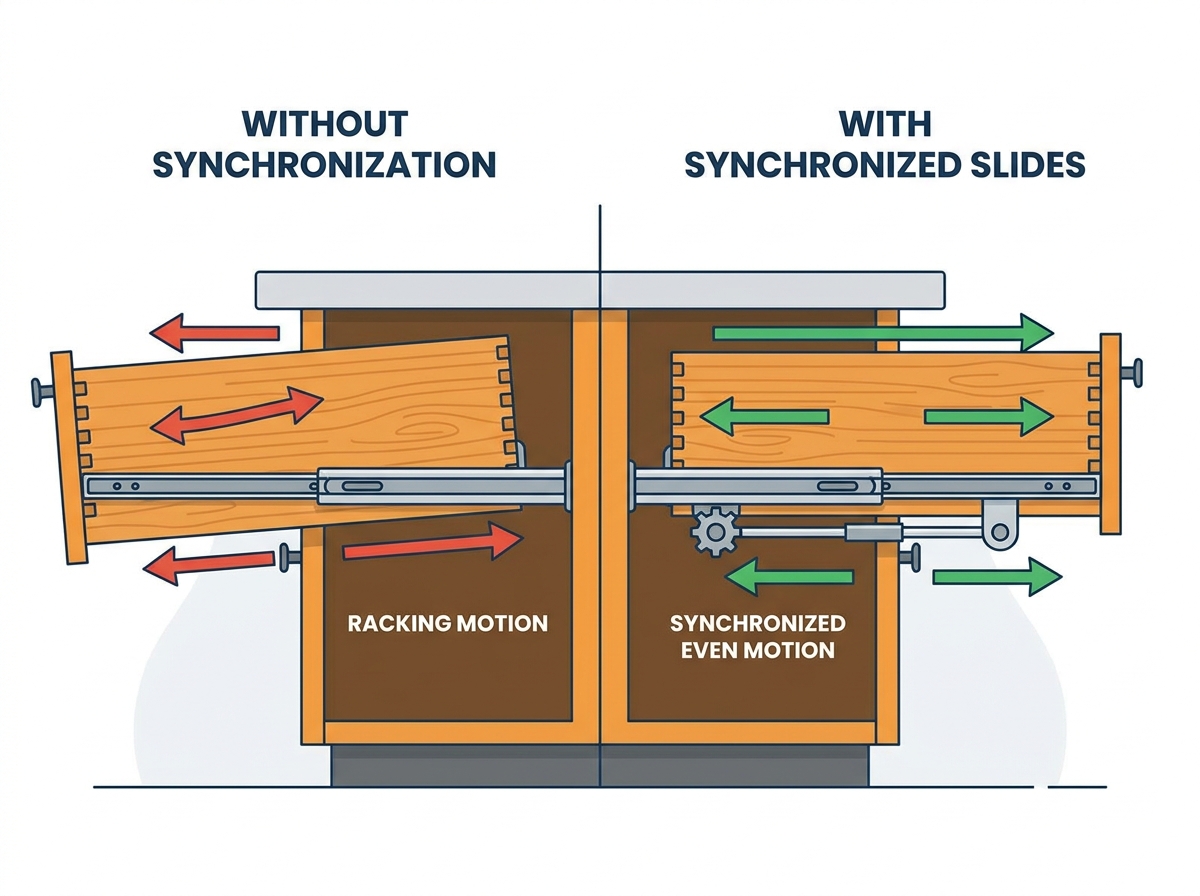
To defeat the racking effect, engineers developed a mechanical linkage system that forces cooperation between the two independent runners. The core of this technology relies on a synchronization linkage structure. A lateral aluminum rod, utilizing a rack-and-pinion gear system, physically bridges the gap between the left and right slide profiles. When you pull the drawer, the gear on the active side turns the rod. The rod instantly rotates the gear on the opposite side. This mechanical transfer forces both runners to advance at the exact same millimeter per second. The drawer cannot twist because the hardware physically prevents independent movement.
This linkage system pairs perfectly with modern dampening technology. When you integrate a synchronization rod into full-extension soft-close undermount slides, the operational benefits multiply. Soft-close mechanisms rely on pneumatic or hydraulic cylinders to catch the drawer and pull it shut silently. In a wide drawer without synchronization, one cylinder often engages before the other. This creates a jarring, twisting motion right before the drawer closes. Synchronization forces both dampening cylinders to engage simultaneously. The drawer glides shut in a perfectly straight line, eliminating yaw and twisting at the final stage of closure.
Forcing parallel movement does more than improve the feel of the drawer; it drastically extends the hardware's lifespan. Standard slides suffer from uneven friction. When a drawer racks, the steel ball bearings or synthetic rollers bear uneven loads. The side receiving the pull force grinds aggressively against the track housing. Synchronized systems distribute the friction evenly across all load-bearing surfaces. By keeping the drawer box perfectly aligned, the internal rollers experience uniform wear. This friction reduction allows the hardware to survive heavy dynamic loads and high-frequency use for decades without degrading.
The architectural advantages of undermount hardware go far beyond mechanical stability. When evaluating undermount drawer slide benefits, space optimization stands out immediately in the shop. Undermounts require minimal side clearance. You generally only need a quarter-inch of total side clearance (an eighth of an inch per side) between the drawer box and the cabinet opening. This allows you to build the drawer box significantly wider compared to side-mount alternatives. In a large bank of kitchen cabinets, reclaiming three-quarters of an inch per drawer adds up to substantial usable storage space across the entire elevation.
Concealed aesthetics drive the popularity of undermount systems in high-end woodworking. Side-mount slides expose industrial metal tracks covered in grease every time you open the drawer. This disrupts the visual flow of custom wood grain, dovetail joinery, and fine craftsmanship. Undermount slides hide entirely beneath the drawer box. The user sees only the solid wood sides and the clean joints. This invisible support system preserves the architectural integrity of the furniture while delivering industrial-grade performance behind the scenes.
Dynamic load distribution represents another critical structural advantage. Side-mount slides hang the drawer box in the air, relying entirely on the shear strength of small mounting screws driven horizontally into the drawer sides. Over time, heavy loads can strip these screws, causing the drawer to sag or detach. Undermount systems cradle the drawer box from below. The entire weight of the drawer and its contents transfers directly downward into the rigid steel profile of the slide. The slide then transfers that weight into the cabinet carcass. This downward load path is structurally superior, allowing undermounts to handle heavy cast iron pans or dense file folders without risking fastener failure.
Selecting the right hardware requires understanding strict engineering limits and shop standards. Drawer width-to-depth ratios dictate exactly when synchronization becomes mandatory. As a general industry rule, if the width of the drawer exceeds its depth by a ratio of 1.5 to 1, you risk racking. Once a drawer surpasses 30 inches in width, standard slides will struggle to maintain parallel motion. At 36 inches and beyond, a synchronization linkage structure is an absolute requirement for smooth operation and long-term reliability.
Builders frequently misunderstand the depth matching rule. Undermount slides demand rigid, unforgiving sizing. A 21-inch undermount slide requires a drawer box with an exact 21-inch outside depth. You cannot put an 18-inch drawer box on a 21-inch slide. The slide mechanism relies on a rear mounting hook that drills into the back of the drawer box, and a front locking device that snaps onto the front underside. This distance is fixed. If the drawer box depth does not match the slide length perfectly, the locking mechanisms cannot engage, and the drawer will slide right off the tracks when pulled.
Evaluating weight capacities requires distinguishing between static and dynamic loads. Static load refers to the weight the slides can hold while the drawer is completely closed and at rest. Dynamic load refers to the weight the slides can support while the drawer is fully extended and in motion. Always size your hardware based on the dynamic load rating. Furthermore, you must factor in the weight of the wide drawer box itself. A 40-inch wide drawer built from 5/8-inch hardwood can easily weigh 20 pounds before you put a single item inside. If your slides have a 75-pound dynamic rating, you only have 55 pounds of actual storage capacity.
Cycle testing separates premium hardware from cheap imitations. Look for slides tested to ANSI/BHMA standards. A 50,000-cycle rating is standard for residential use, but wide, heavy drawers benefit from 100,000-cycle ratings. Stick to established hardware ecosystems. Premium manufacturers engineer their synchronization rods natively to match their specific slide profiles. Avoid aftermarket hacks or universal synchronization kits, as they rarely match the precise gear ratios required for flawless parallel movement.
Feature | Standard Undermount Slides | Synchronized Undermount Slides |
|---|---|---|
Maximum Recommended Width | Up to 30 inches | 30 to 48+ inches |
Lateral Stability | Relies entirely on drawer box rigidity | Mechanically forced parallel movement |
Soft-Close Engagement | Can engage unevenly on wide spans | Simultaneous engagement guaranteed |
Installation Complexity | Standard rear notch and front bore | Requires exact rod cutting and gear alignment |
Primary Use Case | Standard kitchen and vanity cabinets | Wide islands, wardrobes, lateral files |
Identifying the right environment for this hardware ensures optimal performance and prevents callbacks. Exploring undermount slide applications reveals specific zones where synchronization is non-negotiable. Kitchen islands represent the most common residential use case. Modern kitchen designs heavily favor deep, wide pot-and-pan drawers ranging from 36 to 48 inches wide. These drawers hold heavy cast iron skillets, Dutch ovens, and stacked ceramics. This creates severe, uneven weight distribution. A synchronized slide handles this high-frequency, heavy-load environment effortlessly, allowing a user to open a 48-inch drawer with one finger on the far corner of the handle.
Custom wardrobes and closet systems also demand synchronized hardware. Closet designs frequently incorporate wide, shallow drawers for organizing jewelry, ties, belts, and watches. While the physical weight in these drawers remains low, the extreme width-to-depth ratio makes them highly susceptible to racking. Pulling a 40-inch wide, 14-inch deep jewelry drawer from one side will instantly jam standard slides. Heavy lateral file cabinets present a similar challenge. Office environments require smooth, one-handed operation for wide filing systems, making synchronization critical for daily usability and document retrieval.
Commercial and workshop storage environments push hardware to its absolute limits. Workbenches require wide drawers to store long hand tools, levels, and heavy hardware assortments. In a high-frequency commercial setting, employees do not pull drawers gently from the dead center. They grab and yank from whatever angle is most convenient while holding materials in their other hand. Synchronized undermounts absorb this abuse. They keep the heavy tool drawers aligned, preventing the costly downtime associated with repairing jammed or broken cabinet hardware in a production environment.
Upgrading to synchronized hardware does not solve structural woodworking flaws. Preventing sag in extra-wide drawers requires independent mitigation strategies in the shop. If you build a 42-inch wide drawer with a standard 1/4-inch plywood bottom panel, it will bow in the middle under its own weight. The undermount slides only support the extreme left and right edges of the drawer box. To prevent center deflection, you must use 1/2-inch or 5/8-inch material for the bottom panel. Additionally, you must route the bottom panel directly into the drawer sides and front using a dado joint. Even the most expensive synchronized slides cannot fix a structurally weak, sagging drawer box.
Installation demands precision tolerances. Undermount slides have virtually zero lateral tolerance. They do not forgive sloppy carpentry. If your cabinet carcass is out of square by even a sixteenth of an inch, the drawer box will bind. The synchronization mechanism relies on perfectly parallel tracks. Before installing the slides, you must measure the cabinet diagonals to ensure absolute squareness. If the cabinet is a parallelogram, the synchronization rod will bind the gears, rendering the drawer completely inoperable.
Woodworking requirements for undermounts are highly specific. You cannot simply screw the slides to the side of a box. The back of the drawer requires precise notching—typically 35mm wide and 12mm high—to allow the slide profile to pass through. You must also bore specific 6mm holes in the rear panel to accept the slide's steel mounting hooks. At the front of the drawer, you must install brand-specific locking devices. These clips secure the drawer to the slide and offer micro-adjustments for aligning the drawer front. You must follow the manufacturer's boring templates exactly to ensure the locking clips engage correctly.
To prepare a cabinet for synchronized slides, follow these shop procedures:
Measure the internal cabinet width at the front, middle, and rear to confirm the side panels are perfectly parallel.
Cross-measure the cabinet diagonals from corner to corner to verify the carcass is perfectly square.
Cut the aluminum synchronization rod to the exact length specified by the manufacturer's formula (usually internal cabinet width minus a specific deduction).
Snap the pinion gear adapters onto the ends of the cut rod before seating the assembly into the slide housings.
Test the gear engagement by manually sliding the runners back and forth before installing the drawer box.
Synchronized undermount drawer slides are not a luxury upgrade; they are a mechanical necessity for wide cabinetry. When drawer widths exceed 30 inches, the physics of off-center pulling guarantee racking, binding, and eventual hardware failure. By physically linking the left and right runners, synchronized systems force even motion, distribute dynamic loads safely, and preserve the clean aesthetics of custom woodworking.
When shortlisting hardware for your next wide-drawer project, base your selection on rigid criteria. Verify your exact drawer depth to match the slide length perfectly. Calculate your required dynamic load rating by adding the weight of your heavy drawer box to your expected contents. Finally, ensure you select a hardware ecosystem that provides a native, engineered synchronization linkage rod rather than relying on universal aftermarket parts.
To ensure a successful installation, follow these next steps:
Measure your cabinet interior depth and diagonals to confirm absolute squareness before ordering hardware.
Calculate the total dynamic load by weighing your planned drawer box material and adding the maximum expected content weight.
Download the specific manufacturer's boring and routing templates to ensure your rear notches and front locking clips align perfectly.
Upgrade your drawer box bottom panels to a minimum of 1/2-inch thickness to prevent center sag on spans over 36 inches.
A: Most premium manufacturers rate their synchronized undermount slides for drawer widths up to 48 inches. Standard undermount slides without a synchronization rod should generally not exceed 30 inches in width to prevent racking and binding.
A: No. Undermount slides require exact depth matching. A 21-inch slide requires a drawer box with exactly a 21-inch outside depth. The rigid distance between the rear mounting hook and the front locking device cannot be adjusted.
A: Prevent sag by upgrading the drawer bottom panel to at least 1/2-inch or 5/8-inch thick material. Route this thicker panel directly into the drawer sides. The slide mechanism only supports the edges, so the box itself must provide the structural center support.
A: Generally, no. Synchronization modules are rarely universal aftermarket add-ons. They require specific slide profiles engineered with gear housings to accept the linkage rod. You must purchase slides natively designed for synchronization.
A: Standard soft-close slides only dampen the closing action independently on each side. Synchronized slides feature a physical rod that connects both runners, forcing the left and right sides to travel at the exact same speed throughout the entire extension and closing process.


