

close
Choose Your Site
Global
Social Media
Views: 0 Author: Site Editor Publish Time: 2026-08-06 Origin: Site


Cabinet makers constantly balance hardware costs against client expectations for usability, durability, and a premium tactile feel. Before debating extension lengths, professionals specify undermount slides over traditional side-mounts to completely hide the hardware. This approach ensures a cleaner aesthetic and showcases the underlying drawer box craftsmanship. However, specifying the wrong drawer slide extension type creates cascading problems on the shop floor. It impacts material margins, installation time, drawer box construction tolerances, and long-term liability for sagging or failure. You need to choose the right hardware for the specific application. This guide evaluates the technical and commercial trade-offs between partial and full extension undermount slides. We provide a practical framework to help cabinet shops standardize their hardware specifications. You will learn how to balance extension types to maximize profitability, streamline installation, and maintain strict quality control across all your custom cabinetry projects.
Full extension undermount slides provide 90–100% travel, maximizing rear access, but require stricter installation tolerances and carry higher upfront unit costs.
Partial extension undermount slides (typically 50% to 75% travel) offer a highly cost-effective solution for shallow depth applications, vanities, or budget-constrained commercial projects.
Drawer box construction dimensions—specifically depth, undercut, and rear notch requirements—must be strictly aligned with the chosen extension type to prevent assembly bottlenecks.
Standardizing an undermount slide product range across a shop can drastically reduce inventory complexity, streamline CNC programming, and minimize installation errors.
Understanding the mechanical differences across various types of undermount drawer slides is the first step in optimizing your shop's hardware specifications. Extension length directly dictates the internal mechanism design. This design affects load capacity, installation requirements, and the end-user experience. You cannot simply swap one for the other without adjusting your drawer box dimensions and cabinet clearances.
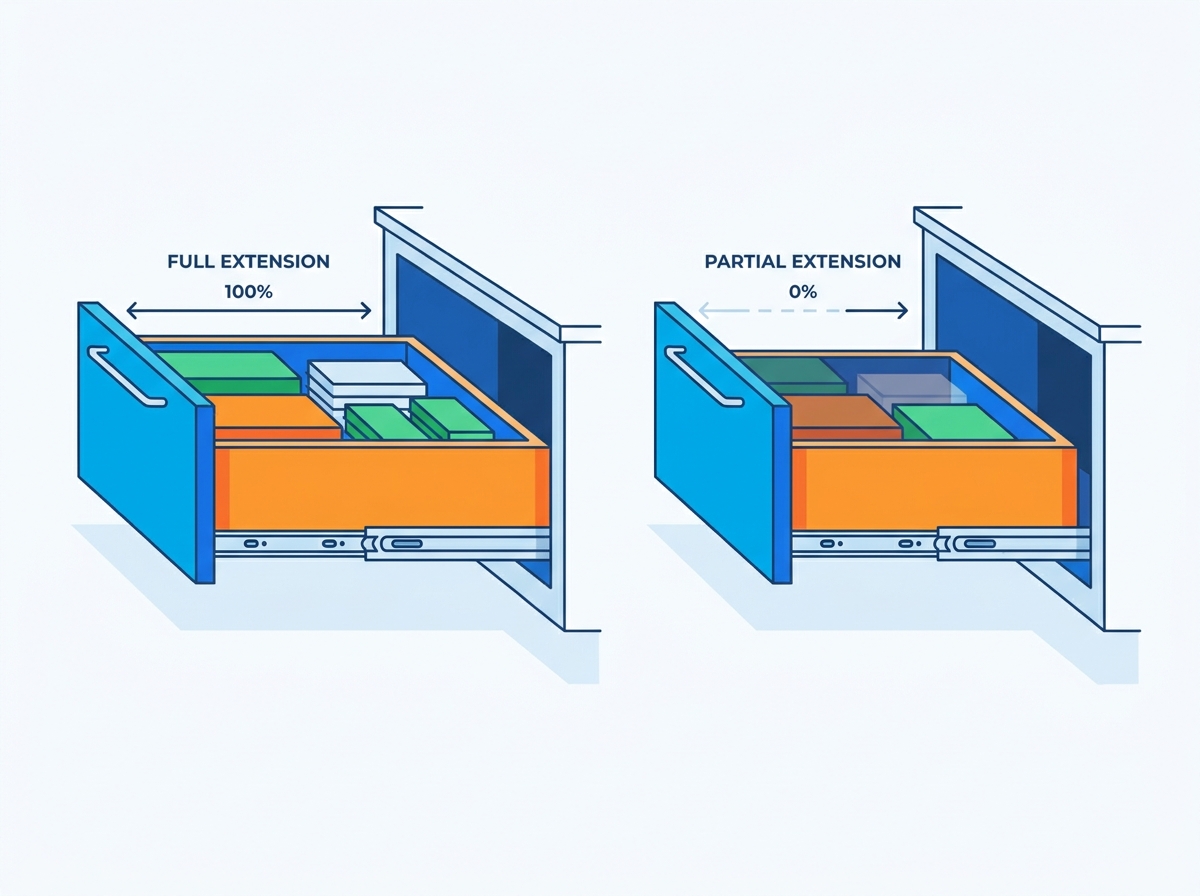
The technical definition of a partial extension slide is straightforward. The drawer box extends to expose roughly half to three-quarters of its total depth. This design limits full access to the back of the drawer. Users must reach under the cabinet counter or into the dark recess of the drawer box to retrieve items stored at the rear. For a standard 21-inch deep drawer, a partial extension slide might leave 5 to 7 inches of the drawer box inside the cabinet carcass.
The mechanism design relies on a simpler two-member profile. You have a cabinet member fixed to the cabinet side and a drawer member that glides out. This two-part system reduces the number of moving parts. It lowers the overall slide weight and minimizes mechanical complexity. Fewer steel components and bearings translate directly to a lower manufacturing cost. The simplified track also means there is less friction during the initial pull force, often resulting in a very smooth opening action even on lighter-duty models.
Cabinet makers specify partial extension undermount slides for specific, targeted use cases. They excel in bathroom vanities where drawer depths are typically shallow. A 15-inch deep vanity drawer does not require full extension to reach the back comfortably. They also serve well in budget-tier cabinetry, shallow desk drawers, and basic closet systems. In these applications, rear-drawer access is not critical to the user's daily routine, making the cost savings highly justifiable.
The technical definition of full extension undermount slides involves maximum travel. The drawer box clears the cabinet face entirely. In some manufacturer specifications, travel equal to or greater than 90% is classified as full extension. This design allows completely unobstructed access to the back of the drawer. Users can lift items straight up without angling them under the countertop or cabinet frame.
The mechanism design is significantly more complex. It requires a three-member profile. You have a cabinet member, an intermediate member, and a drawer member. The intermediate member bridges the gap, supporting the drawer member as it travels past the cabinet face. High-quality versions utilize synchronized movement. Rack and pinion gears or specialized bearing carriages ensure all three members move in unison. This synchronization prevents the intermediate member from lagging or slamming, maintaining stability and smooth operation at maximum extension. Without synchronization, the ball bearing retainers can migrate, causing the drawer to bind or fail to close completely.
You will also encounter the over-travel variant. This specialized subset provides 100%+ travel. It pulls the drawer box just beyond the cabinet face, usually by an extra inch or more. Over-travel slides are ideal for clearing thick countertop overhangs. They also provide crucial clearance for accessing deep file drawers where hanging folders might catch on the cabinet frame above.
Primary use cases for full extension hardware center on high-utility spaces. Deep kitchen pots and pans drawers demand full extension. Premium custom cabinetry relies on this hardware to deliver a luxury feel. Pantry roll-outs and highly utilized workstation storage also require full access to maximize usable space and improve ergonomics.
Choosing between extension types requires a rigorous technical evaluation. You must assess how the hardware performs under load, how it optimizes interior space, and how it impacts your project margins. Relying on guesswork or defaulting to the cheapest option will lead to callbacks and damaged reputations.
You must understand the difference between dynamic and static load ratings. Static load refers to the weight a slide can hold while stationary. Dynamic load refers to the weight it can support while opening and closing over a specified number of cycles, typically 50,000 to 100,000 cycles. Mechanical leverage changes drastically when a drawer is fully extended. A fully loaded drawer pulled completely out acts as a lever. It exerts immense torque on the cabinet member screws and the internal bearings. Partial extension slides experience less torque because a significant portion of the drawer remains supported inside the cabinet housing.
Deflection and stability are critical metrics. Deflection is the downward sag of the drawer front when fully opened. The third member in full extension slides introduces more potential for deflection and side-to-side play. High-quality full extension hardware combats this with thicker steel profiles and tighter bearing tolerances. They maintain stability at maximum capacities, typically ranging from 75 lbs to 130+ lbs. If you specify cheap full extension slides, the deflection will cause the drawer front to rub against the door or drawer below it, ruining the reveal alignment.
Long-term durability varies between the designs. Assessing wear-and-tear differences is essential. A simpler two-member partial extension profile has fewer points of failure. However, the complex, synchronized three-member full extension mechanism is engineered for decades of daily use in demanding environments. The synchronization gears prevent the ball bearing retainers from migrating, which is a common cause of failure in non-synchronized slides. You must verify the cycle testing data provided by the manufacturer before committing to a bulk purchase.
Volume utilization is a primary selling point for custom cabinetry. You must calculate lost interior volume versus accessible volume. Partial extension slides create a dead zone at the rear of the drawer. While the physical volume exists, it is practically inaccessible for daily use. Items pushed to the back stay at the back. Full extension slides convert 100% of the interior volume into accessible storage, allowing homeowners to utilize every square inch of their cabinetry.
Ergonomic considerations often dictate the specification. Full extension is functionally non-negotiable for deep lower cabinets. Bending down and reaching into a dark, 24-inch deep cabinet is physically straining. For aging-in-place designs or ADA-compliant spaces, reaching into the back of a drawer presents a significant physical barrier. Full extension hardware brings the contents out to the user, eliminating the need to stoop, stretch, or use a flashlight to find a pot lid.
Unit cost comparison is a daily reality for shop owners. Analyzing the percentage cost increase when upgrading from partial to full extension hardware is vital. Full extension slides inherently cost more due to the extra steel, bearings, and complex synchronization mechanisms. Across a large kitchen with 20 to 30 drawers, this upgrade represents a measurable increase in hardware expenditure. You must account for this in your initial bidding process.
However, you must factor in perceived value. The end-user's perception of a premium feel justifies the hardware upgrade in custom residential bids. When a homeowner opens a drawer and it glides out completely, exposing the dovetail joinery at the rear, it communicates quality. This unhindered access and smooth operation allow cabinet makers to command higher overall project prices, protecting and often increasing profit margins despite the higher upfront hardware cost.
Performance Metric | Partial Extension Undermount | Full Extension Undermount |
|---|---|---|
Travel Distance | 50% to 75% of drawer depth | 90% to 100%+ of drawer depth |
Mechanism Profile | Two-member (Cabinet & Drawer) | Three-member (Cabinet, Intermediate, Drawer) |
Dynamic Load Capacity | Typically 50 lbs to 75 lbs | Typically 75 lbs to 130+ lbs |
Deflection Risk at Max Load | Low (shorter lever arm reduces torque) | Moderate (requires high-quality steel to resist sag) |
Synchronization | Rarely required | Highly recommended to prevent bearing migration |
Ideal Applications | Vanities, shallow desks, budget closets | Kitchens, deep storage, premium custom built-ins |
Specifying the slide is only half the battle. The physical realities of building the drawer box and installing the hardware dictate the success of the project. Undermount slides demand strict adherence to dimensional tolerances. A deviation of just 1/16 of an inch can cause the drawer to bind, scrape, or fail to engage the soft-close mechanism.
Material thickness requirements are non-negotiable. You must ensure the side wall thickness of your drawer box matches the specific slide's design parameters. Most undermount slides are engineered for either 1/2-inch or 5/8-inch drawer side material. If you use 5/8-inch material on a slide designed for 1/2-inch, the drawer box will be too wide to fit between the cabinet members. The slides will bind immediately. If you use 3/4-inch material, you must rout the bottom edges of the drawer sides down to 5/8-inch or 1/2-inch to fit the slide profile.
Undercut and rear notch specifications require precise machining. The undercut is the recessed space under the drawer bottom where the slide mechanism sits. This is typically 1/2-inch. You must identify whether dimensions differ when switching between partial and full extension within the same manufacturer's line. Often, the rear notch depth or the location of the rear bore hole changes. The rear notch allows the drawer to slide over the back of the runner. The bore hole accepts the metal hook that secures the back of the drawer box. If the bore hole is off by a few millimeters, the drawer will not sit flat on the runners.
Mounting and setbacks require standardized procedures. You must establish jig requirements, mounting hole locations, and cabinet member setback measurements. The setback is the distance from the front edge of the cabinet to the first screw hole on the slide. This measurement changes based on whether you are building inset, overlay, or frameless cabinetry. Consistent setback measurements prevent drawers from protruding or sitting too far back. Using a dedicated mounting jig ensures every slide is installed at the exact same depth and height.
Front locking device variations significantly impact installation speed. These devices attach to the bottom front corners of the drawer box and snap onto the slide runners. You must evaluate the availability of 1D, 2D, 3D, and 4D adjustment capabilities across different extension types. 1D offers basic height adjustment. 2D adds side-to-side movement. 3D includes depth adjustment for inset faces. 4D adds tilt adjustment to align the drawer front perfectly vertical. These adjustments are crucial for finalizing reveal alignments across a bank of drawers. Full extension slides typically offer more advanced 3D and 4D locking devices compared to partial extension models.
Cabinet squareness is the most common point of failure. You must address racking and out-of-square cabinet boxes before installing hardware. Undermount slides run on precise parallel tracks. Full extension slides are significantly less forgiving of poor cabinet assembly than partial extension models. If the cabinet is wider at the back than the front, the three-member full extension slide will pull apart and bind as it extends. You must measure diagonally across the cabinet opening to ensure perfect squareness before driving the first screw.
Wide drawer management presents another challenge. Managing slide synchronization issues in wide drawers is critical. When a drawer exceeds 30 inches in width, pulling it from one side can cause the slide mechanism to rack and bind. This is especially problematic with full extension hardware holding heavy loads like cast iron pans. You must know when to specify lateral stabilizers. These stabilizers connect the left and right slides with a metal pinion rod, forcing them to move simultaneously regardless of where the user pulls the handle.
Running a profitable cabinet shop requires operational efficiency. Standardizing your undermount slide product range minimizes errors, speeds up production, and simplifies purchasing. Every time you introduce a new slide model to the shop floor, you introduce a new opportunity for a machining or assembly error.
Operational drag destroys margins. The financial and operational burden of stocking multiple slide types is immense. SKU bloat ties up capital in unused inventory. You end up with random pairs of 15-inch partial extension slides and 21-inch full extension slides gathering dust. It causes assembly line confusion. Installers frequently mix up locking devices, trying to force a partial extension clip onto a full extension runner. This results in broken plastic parts, wasted labor hours, and delayed installations.
CNC programming overhead is another hidden cost. Maintaining separate parametric libraries for partial versus full extension drawer boxes takes time. Every time a manufacturer updates a slide specification, your engineer must update multiple digital libraries in your cabinet design software. If an operator runs the partial extension program for a full extension drawer, the rear notches will be cut in the wrong location. The entire drawer box must be scrapped, wasting expensive maple or birch plywood.
To eliminate these inefficiencies, implement a strict tiered hardware strategy. Define exactly what hardware goes into what type of project, and do not deviate without a signed change order.
Tier 1 represents your Base or Commercial level. Standardize on partial extension slides for multi-family developments, standard bathroom vanities, and basic closet systems. These projects are highly price-sensitive. Partial extension protects your margins while still delivering the concealed undermount aesthetic that clients expect.
Tier 2 represents your Premium or Residential level. Standardize on full extension undermount slides for all kitchen projects, high-end built-ins, and master bathroom suites. In this tier, client satisfaction and ergonomic access are paramount. The higher project budget easily absorbs the increased hardware cost, and the superior tactile feel reinforces your brand's quality.
Tier 3 represents Specialty applications. Reserve heavy-duty full extension slides (rated for 130+ lbs) and over-travel slides for specific problem areas. Use these for oversized pots and pans drawers, heavy waste pull-outs, and deep file storage. Keep a limited stock of these specialty slides and order them strictly on a per-project basis to avoid tying up cash flow.
Audit your current hardware inventory to identify redundant slide SKUs and eliminate overlapping brands to free up working capital.
Update your shop's CNC parametric libraries to lock in the exact undercut, rear notch, and boring dimensions for your newly standardized primary slide.
Build a physical drawer box mockup using your chosen full extension slide and load it with 75 pounds to establish a baseline for acceptable deflection.
Train your assembly team on the specific 3D and 4D adjustment capabilities of the front locking devices to speed up final reveal alignment on the job site.
A: Partial extension slides typically allow the drawer to travel 50% to 75% of its total depth, leaving the back section inside the cabinet. Full extension slides provide 90% to 100% travel, allowing the drawer box to clear the cabinet face entirely for complete access to the rear.
A: Usually, no. While the outside width deductions and bottom recess might be identical, the rear notch depth and the location of the rear hook bore hole frequently differ between partial and full extension models, even within the same manufacturer's product line.
A: Yes, they have a higher risk of deflection because the drawer extends further, creating a longer lever arm. However, high-quality full extension slides use thicker steel and a synchronized three-member mechanism to counteract this torque and prevent noticeable sagging under rated loads.
A: Specify over-travel slides when the cabinet design includes a thick, protruding countertop overhang that would block access to the back of the drawer. They are also essential for deep file drawers to ensure hanging folders clear the cabinet frame completely during removal.
A: Yes, in most hardware systems, the front locking devices are specific to the slide's extension type. Partial extension clips often have simpler mechanisms with fewer adjustment planes, while full extension clips frequently offer 3D or 4D adjustments for precise reveal alignment.
A: Full extension hardware generally requires a more robust build to achieve the same load rating as a partial extension slide. A partial extension slide easily holds 75 lbs because it remains partially supported by the cabinet, whereas a full extension slide requires a complex track to support 75 lbs fully extended.


