

close
Choose Your Site
Global
Social Media
Views: 0 Author: Site Editor Publish Time: 2026-08-10 Origin: Site


The architectural shift toward minimalist, handleless cabinetry forces a critical hardware decision at the drawer level, where aesthetic goals frequently collide with daily functional realities. Selecting the wrong motion technology compromises user experience, leading to disrupted cabinet face alignment, accidental drawer deployments, premature hardware failure, or excessive wear and tear on the cabinet carcass. Cabinetmakers and installers face constant pressure to deliver seamless elevations without sacrificing usability. Evaluating the mechanical trade-offs between soft-close and push-to-open systems requires analyzing actuation force, installation tolerances, budget tiers, and long-term durability to specify the correct hardware for high-traffic versus low-traffic zones. We will break down the exact engineering differences, load capacities, and field-tested installation methods. You will learn how to match the right runner system to specific cabinet zones, ensuring your next handleless kitchen build operates flawlessly while maintaining strict reveal tolerances.
Actuation Mechanics: Push-to-open systems rely on spring-loaded ejection requiring pushing force, while soft-close systems rely on fluid or pneumatic dampers requiring pulling force.
Aesthetic vs. Ergonomic Trade-offs: True handleless designs require push-to-open hardware, whereas soft-close systems in handleless setups necessitate routed finger pulls or extruded channels.
Maintenance Realities: Push-to-open systems require direct contact with the drawer face, leading to frequent cleaning of fingerprints on slab doors, whereas soft-close with pulls protects the cabinet finish.
Installation Precision: Push-to-open mechanisms demand stricter depth tolerances (typically a 2-3mm trigger gap) to function reliably without false triggers or binding.
Hybrid Viability: Synchronized push-to-open with soft-close mechanisms exist but introduce higher costs, complex installation, and specific drawer-weight minimums to function correctly.
Understanding the baseline engineering of concealed drawer slides establishes the foundation for successful handleless applications. These systems mount entirely beneath the drawer box, hiding the metal tracks from view when the drawer is open. This bottom-mounting geometry changes how weight transfers to the cabinet carcass. Instead of hanging off side-mounted ball bearings, the drawer load pushes directly downward onto the runner profiles. This vertical load distribution significantly increases weight capacity and lateral stability, preventing the drawer from sagging when fully extended.
Implementing this hardware requires strict adherence to drawer box construction parameters. Cabinetmakers cannot use standard flush-bottom drawers. The box requires a specific bottom recess, typically 1/2-inch (13mm), to conceal the slide mechanism. The back panel of the drawer requires precise notching. Installers usually cut a notch 35mm wide and 12mm high on both the left and right sides of the rear panel. A 6mm bore hole drilled into the back of the drawer box allows the steel hook at the rear of the slide to engage, locking the back of the drawer in place.
Side material thickness dictates which specific slide model you must order. Manufacturers engineer slides for specific material thicknesses, usually 12-13mm (1/2-inch) or 16-19mm (5/8 to 3/4-inch). If you attempt to force a drawer box built with 19mm sides onto a slide designed for 16mm material, the drawer will bind against the cabinet sides and fail to operate. The locking devices attached to the front underside of the drawer box secure the front of the drawer to the runner. These clips snap onto the slide and feature adjustment dials. Modern 4D locking clips allow installers to adjust the drawer face up, down, left, right, in, and out, ensuring perfect reveals across a wall of cabinets.
Coordinating drawer slide actuation with matching cabinet door hinges ensures a predictable user experience. If a kitchen features push-to-open drawers, the cabinet doors should utilize push-to-open magnetic latches and unsprung hinges. Mixing push-to-open drawers with pull-to-open doors breaks the ergonomic flow of the workspace. You must plan the entire room's hardware schedule before cutting a single sheet of plywood to maintain consistent actuation force across all elevations.
Hardware utilizing integrated dampers controls the final inches of the closing cycle. These mechanisms pull the drawer gently shut after an initial push. The system relies on a spring-loaded catch mechanism that engages a fluid or pneumatic cylinder. As the drawer approaches the cabinet face, the catch grabs the runner profile. The internal spring pulls the drawer inward, while the damper resists that pull, absorbing the kinetic energy. This controlled resistance slows the momentum and retracts the drawer silently until it rests flush against the cabinet frame.
The functional advantages of soft-close undermount slides center on acoustic control and hardware preservation. Slam prevention ensures a completely silent closing experience, preventing the sharp crack of wood hitting wood. The damping action significantly reduces kinetic stress on the drawer joinery. Dovetails and dowel joints last decades longer when they do not absorb impact force multiple times a day. The self-closing action guarantees the drawer rests perfectly flush with the cabinet face every time, eliminating the sloppy look of partially open drawers.
Limitations emerge when applying this technology to handleless designs. Because the internal spring holds the drawer shut tightly, users must pull against this tension to open the drawer. Without decorative hardware, you must provide a physical grip integrated into the cabinetry.
Routed J-Pulls: The cabinetmaker routes a continuous J-shaped channel into the top edge of the drawer face. This requires thick material (usually MDF or solid wood) and adds significant labor time for routing, sanding, and finishing the profile.
Extruded C-Channels: Installers notch the cabinet carcass and install a continuous aluminum C-channel behind the drawer faces. This allows users to reach behind the flat slab door to pull it open. This method reduces the usable interior height of the cabinet.
Beveled Edges: Cutting a 45-degree bevel on the top edge of the drawer face provides a minimal finger hold, though it offers less grip than a J-pull.
Ergonomic strain becomes a factor with heavy, fully loaded drawers. Pot and pan drawers or heavy pantry pullouts demand significant pulling force to overcome the initial spring tension. Users with limited grip strength often struggle with heavy soft-close drawers in handleless configurations.
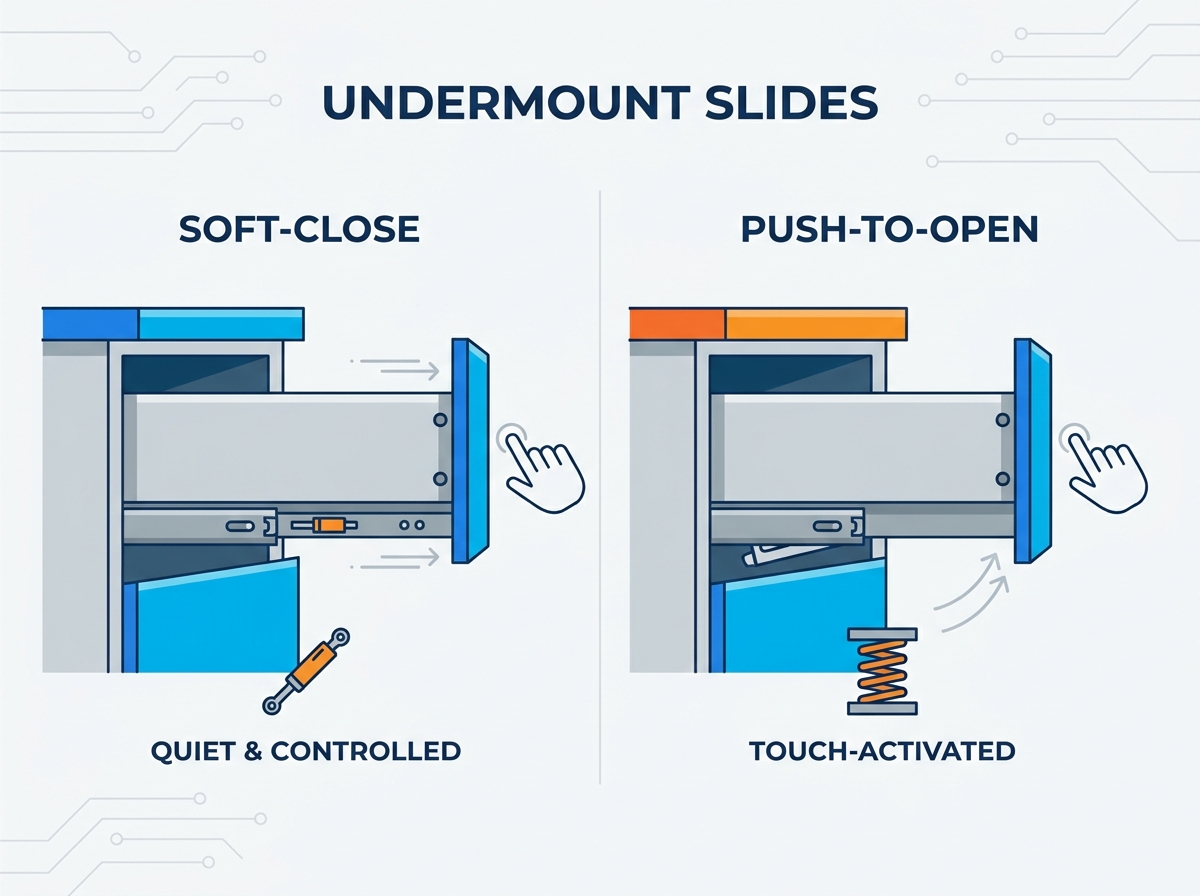
This solution utilizes a mechanical spring-release trigger activated by inward pressure on the drawer front. A cam inside the slide holds a compressed spring in tension. Pushing the drawer face inward releases the cam. The spring fires, ejecting the drawer forward by two to four inches. The user then grasps the edges of the drawer face to pull it open fully. This technology eliminates the need for any external pulling force, changing the fundamental interaction from pulling to pushing.
The functional advantages cater directly to modern design trends. Push-to-open undermount slides enable a true, uninterrupted slab-door aesthetic. Designers achieve zero edge routing and eliminate visible metal channels. The result is a monolithic, clean cabinet elevation. Hands-free operation provides immense practical value in active environments. Users can trigger the opening mechanism with a knee or hip. When hands are wet or holding raw meat, opening a waste-bin pullout with a knee prevents cross-contamination.
The bounce-back effect presents the most common user frustration. Drawers must be pushed shut manually to reset the internal spring. If a user shoves the drawer closed too aggressively, the cam fails to catch, and the kinetic energy causes the drawer to bounce back open. Users must learn to close the drawer with deliberate, controlled force. Accidental actuation also happens frequently. Leaning against base cabinets to reach upper shelves can inadvertently trigger the opening mechanism, causing drawers to pop open against the user's legs.
Aesthetic gaps require careful management. The system requires a visible 2.5mm to 3mm gap between the back of the drawer front and the cabinet frame. This gap allows the trigger enough travel distance to activate. Installers use specialized depth-adjustable locking clips and rubber bumper pads to maintain this exact gap. Surface maintenance increases dramatically on handleless slab doors. Constant physical contact leads to smudges and fingerprints. Matte, gloss, or acrylic finishes show these marks clearly, requiring frequent wiping to maintain a clean appearance.
Evaluating these two systems requires looking at specific dimensions of daily use, installation complexity, and long-term maintenance. Ergonomics and accessibility play a massive role in the specification process. You must assess pushing strength versus pulling strength based on the end-user. Aging-in-place designs often favor push mechanisms because they do not require tight grasping or pinching motions.
Aesthetic purity drives many architectural decisions. You must evaluate the visual impact of trigger gaps versus continuous aluminum extrusions. Push-to-open leaves a small shadow line gap but keeps the drawer face completely solid. Soft-close requires a routed channel or metal extrusion, breaking the continuous wood grain or painted surface. Acoustics also differ wildly. Soft-close offers silent operation. Push-to-open produces an audible mechanical click when the trigger engages and disengages.
Evaluation Criteria | Soft-Close Undermount Slides | Push-to-Open Undermount Slides |
|---|---|---|
Actuation Force | Requires active pulling strength to overcome spring tension. | Requires light pushing force to trigger spring ejection. |
Closing Action | Self-closing, damped, silent, and anti-slam. | Manual closing required to reset the internal spring. |
Handleless Prep | Requires routed J-pulls, C-channels, or edge bevels. | Allows true flat slab doors with zero edge routing. |
Reveal Tolerance | Drawers pull tight and flush against the cabinet frame. | Requires a mandatory 2.5mm - 3mm trigger gap. |
Acoustics | Silent operation during the closing cycle. | Audible mechanical click during actuation and reset. |
Surface Maintenance | Fingers touch the routed pull, protecting the face finish. | High fingerprint transfer directly on the drawer face. |
Quality tiers dictate reliability. The performance gap between generic brands and premium manufacturers is significantly wider for push-to-open mechanisms than for standard soft-close. Cheap push triggers fail quickly. The plastic cams wear down, or the springs lose tension, resulting in drawers that refuse to stay closed. Maintenance frequency and the likelihood of mechanism fatigue over 50,000 cycles must guide your purchasing decision. Investing in premium hardware prevents costly callbacks and replacements.
Advanced runner systems attempt to solve the handleless dilemma by combining both technologies into a single unit. These hybrid slides feature mechanical ejection paired with damped closing. You push the drawer face to trigger the ejection spring. When you are done, you push the drawer closed, and a fluid damper catches it, pulling it shut silently for the final two inches.
Understanding how undermount slides work in a hybrid setup reveals complex engineering. The system relies on a delicate tension balancing act. The ejection spring must be strong enough to push the drawer open against the resistance of the damper. Conversely, the damper must be strong enough to catch the drawer and pull it shut, but not so stiff that it prevents the ejection spring from resetting during the closing stroke.
Implementation realities make these systems difficult to deploy on standard jobs. They enforce strict weight parameters. Drawers that are too light will not generate enough momentum to reset the mechanism. An empty 12-inch wide drawer often lacks the mass required to compress the damper and reset the spring simultaneously. This results in a drawer that bounces back or stops an inch short of closing. Installers must carefully calculate the combined weight of the drawer box and its intended contents. Fine-tuning the tension dials on hybrid systems requires patience and significant installation experience to achieve consistent operation across a whole kitchen.
Hardware specification carries inherent risks that manifest during installation or after months of daily use. Sagging or racking in wide drawers happens frequently with push-to-open systems. When a user pushes off-center on a 36-inch wide drawer, the slide on the pushed side triggers, while the opposite slide binds. This causes the drawer to twist in the opening, jamming the tracks.
The mitigation strategy requires the mandatory specification of synchronization rods. Any drawer exceeding 24 inches in width needs a sync rod. This aluminum or plastic rod links the left and right trigger mechanisms at the rear of the slides. Pushing anywhere on the drawer face rotates the rod, activating both slides simultaneously. This ensures a smooth, parallel ejection regardless of where the user applies pressure.
Field Issue | Common Cause | Mitigation / Fix |
|---|---|---|
Drawer Racking | Off-center pushing on wide drawers without a sync rod. | Install a synchronization rod on all drawers over 24 inches wide. |
Trigger Fails to Fire | Trigger gap is too tight; drawer hits frame before cam releases. | Adjust 4D locking clips inward to establish a full 2.5mm gap. |
Drawer Bounces Open | Closing force is too high, or drawer is too light (hybrid slides). | Adjust spring tension dials; add weight to the drawer box. |
Slide Binding | Drawer box is built out of square or exceeds width tolerances. | Rebuild box to exact interior cabinet width minus slide deductions. |
Hardware failure due to dynamic load exceedance ruins cabinetry. Overloaded drawers destroy the ball bearing tracks and snap the plastic trigger components. You must match the slide's dynamic weight rating strictly to the intended contents, factoring in the weight of the drawer box itself. A heavy maple drawer box consumes a large portion of a standard 75-pound weight rating. For heavy storage like cast iron pans or dishware, upgrade to 130-pound or 150-pound rated slides. Over-engineering the weight capacity prevents premature failure and ensures smooth operation.
Soft-close undermount slides remain the industry standard for durability, cabinet preservation, and acoustic control. They perform flawlessly provided the design can accommodate a routed finger pull or extruded channel. Push-to-open undermount slides are essential for pure minimalist aesthetics but require compromises in closing behavior, surface maintenance, and installation precision. Your choice dictates how users will interact with the space every single day. Specify soft-close hardware for high-traffic kitchens and heavy storage environments. Specify push-to-open hardware for living room built-ins, modern bathroom vanities, and specific functional zones like under-sink waste pullouts.
Calculate exact drawer box dimensions, material thickness, and rear notch requirements before ordering hardware.
Determine dynamic load requirements based on the specific items stored in each cabinet zone, upgrading to heavy-duty slides for pot and pan drawers.
Order a single premium hardware set to construct a physical mock-up of the drawer box and slide mechanism.
Test the actuation force, trigger gap, and synchronization rod on the mock-up before committing to a full-scale cabinet build.
A: You cannot convert standard soft-close slides to push-to-open simply by adding a part. The internal mechanisms differ completely. Soft-close uses a damper to pull the drawer in, while push-to-open uses a spring to eject it. You must replace the entire slide runner system to change the motion technology.
A: Bouncing occurs when the drawer is pushed shut too aggressively or lacks sufficient weight. The kinetic energy overcomes the catch mechanism, causing the spring to re-engage and eject the drawer. Adjusting the spring tension or ensuring the drawer meets the minimum weight requirement usually resolves this issue.
A: Most push-to-open systems require a precise 2.5mm to 3mm gap between the back of the drawer front and the cabinet frame. This space allows the drawer face to travel inward far enough to compress the spring and activate the release trigger.
A: Yes, concealed slides require specific clearances. Because the hardware mounts underneath, you lose about half an inch to five-eighths of an inch of interior vertical depth. You must also account for the required back-notching, which slightly reduces the usable interior front-to-back space.
A: They can aid in ADA compliance because they eliminate the need for tight grasping, pinching, or twisting of the wrist. Users can open them with a closed fist, knee, or hip. However, the force required to push them closed manually must be evaluated against ADA push-force limitations.
A: Standard push-to-open slides typically support 75 to 90 pounds dynamically. Heavy-duty versions from premium manufacturers can support 130 to 150 pounds. You must include the weight of the wooden drawer box itself when calculating the total load on the slides.
A: Preventing fingerprints requires careful material and finish selection. Opt for textured melamine, matte laminates with anti-fingerprint technology, or natural wood grain finishes. High-gloss acrylics and dark matte paints show oils readily. Train users to push the drawer open using the back of the hand or a knee.


