

close
Choose Your Site
Global
Social Media
Views: 0 Author: Site Editor Publish Time: 2026-08-21 Origin: Site


Hardware failure in high-volume furniture production carries massive hidden liabilities. A single defective batch of drawer slides can easily derail production timelines and trigger extensive warranty claims. Procurement managers and furniture designers face a constant, high-stakes challenge. You must distinguish between a flawless golden sample provided by sales representatives and the actual, consistent batch quality delivered at scale. Surface-level aesthetics rarely tell the whole story.
We present a rigorous, evidence-based inspection framework designed to audit potential vendors effectively. This approach moves beyond basic visual checks. It systematically evaluates structural integrity, manufacturing tolerances, and long-term mechanical reliability. By implementing these evaluation standards, you protect your production lines from unexpected bottlenecks. You also ensure that the final product meets the strict performance expectations of end-users.
Material specifications (steel grade, plating thickness) and verifiable cycle testing data are the primary indicators of structural integrity.
A manufacturer’s internal quality control protocols and automation levels dictate batch-to-batch consistency.
Precise dimensional tolerances in the slide mechanism are critical to minimizing assembly line bottlenecks and woodworking adjustments.
Establishing baseline metrics for acceptable defect rates is the first step in hardware procurement. High-volume production lines typically measure these rates in parts per million (PPM). A defect rate that seems negligible on a small scale becomes a massive operational hurdle when producing thousands of units monthly. Defective slides cause immediate assembly line stoppages. Workers must stop to troubleshoot, remove faulty hardware, and install replacements. This downtime destroys daily throughput targets and inflates labor overhead.
Slide quality directly impacts end-user brand perception and long-term warranty liability. When a drawer sags, sticks, or fails to close properly, the end-user blames the furniture brand, not the hardware vendor. This leads to field service calls and replacement shipments that eat directly into profit margins. Furthermore, inconsistent hardware dimensions lead to increased labor costs during the final assembly of drawer boxes. If the slide chassis varies by even a millimeter, the drawer box will not align correctly within the cabinet carcass. This forces assembly workers to make manual adjustments, destroying production efficiency.
Establish a maximum acceptable PPM defect rate before signing any vendor contracts.
Track assembly line downtime specifically related to hardware binding or misalignment.
Monitor warranty claims categorized by mechanical hardware failure versus material defects.
Calculate the exact labor time spent adjusting drawer fronts to compensate for slide variance.
Traditional side-mount slides offer a relatively forgiving installation process. They mount directly to the side of the drawer box and the cabinet interior, allowing for minor spatial discrepancies. Installers can often bend mounting tabs or use oversized screws to force a fit. Concealed undermount systems demand strict spatial and structural requirements. The hardware sits entirely beneath the drawer box, requiring precise bottom recesses and rear notching. There is zero room for error.
Because the slide mechanism is hidden and interacts with specific wooden interlocking points, manufacturer consistency is non-negotiable. If the metal chassis of an undermount slide is warped or improperly stamped, the drawer will not engage with the locking devices. The precision required for undermount systems means that evaluating the vendor's manufacturing capabilities is just as important as evaluating the hardware itself. You are buying their machining tolerances just as much as you are buying their steel.
The foundation of any reliable drawer slide is its base material. Cold-rolled steel (often graded as SPCC) significantly outperforms inferior hot-rolled alloys in both tensile strength and surface finish. Material thickness directly correlates to deflection limits. When a drawer is fully extended under maximum load, the steel must resist bending. Industry-standard heavy-duty slides typically utilize steel gauges between 1.5mm and 2.0mm. Thinner materials will warp, causing the ball bearings or synthetic rollers to bind within their tracks.
Corrosion resistance is equally important, especially for hardware destined for kitchen and bath applications where moisture is constant. Salt spray testing verifies zinc plating thickness and overall rust resistance. A standard requirement is a minimum of 24 to 48 hours of continuous salt spray exposure without showing red rust. Vendors should provide documented metallurgical reports confirming the exact steel grade and plating specifications used in their production runs. Do not accept generic material descriptions.
Evaluating load capacity requires understanding the difference between static and dynamic ratings. Static load ratings measure the weight the slide can hold while at rest. Dynamic load ratings measure the weight the slide can support while in continuous operation. A slide might hold 100 pounds statically but fail after a few hundred cycles when moving that same weight. Always specify dynamic load requirements for your applications.
Industry-standard testing protocols, such as those established by BIFMA or KCMA, evaluate deflection at full extension under maximum dynamic load. These tests measure how far the front of the drawer drops when fully opened. Excessive deflection indicates weak steel or poor track design. If a drawer deflects more than 1/8 inch at full extension, it risks rubbing against the lower cabinet face frame. Always request independent laboratory test reports detailing dynamic load performance rather than relying on in-house marketing claims.
The complexity of undermount slides lies in their motion mechanisms. Soft-close systems rely on dampers and tension springs. Analyze the internal components carefully. Hydraulic dampers generally offer smoother, more consistent fluid dynamics than cheaper pneumatic alternatives. Check the fatigue limits of the internal tension springs. A weak spring will lose its retraction force over time, preventing the drawer from pulling fully closed.
Inspect the durability of plastic or nylon carriage components and ball bearings under continuous friction. These components carry the weight of the drawer and must resist wear. Evaluate the consistency of the glide system engagement. The locking devices must secure the drawer box tightly to the slide chassis without excessive play. If the locking device is loose, the drawer will rattle. The acoustic harshness of the mechanism is also a key indicator of quality; a premium slide operates silently without grinding or clicking noises.
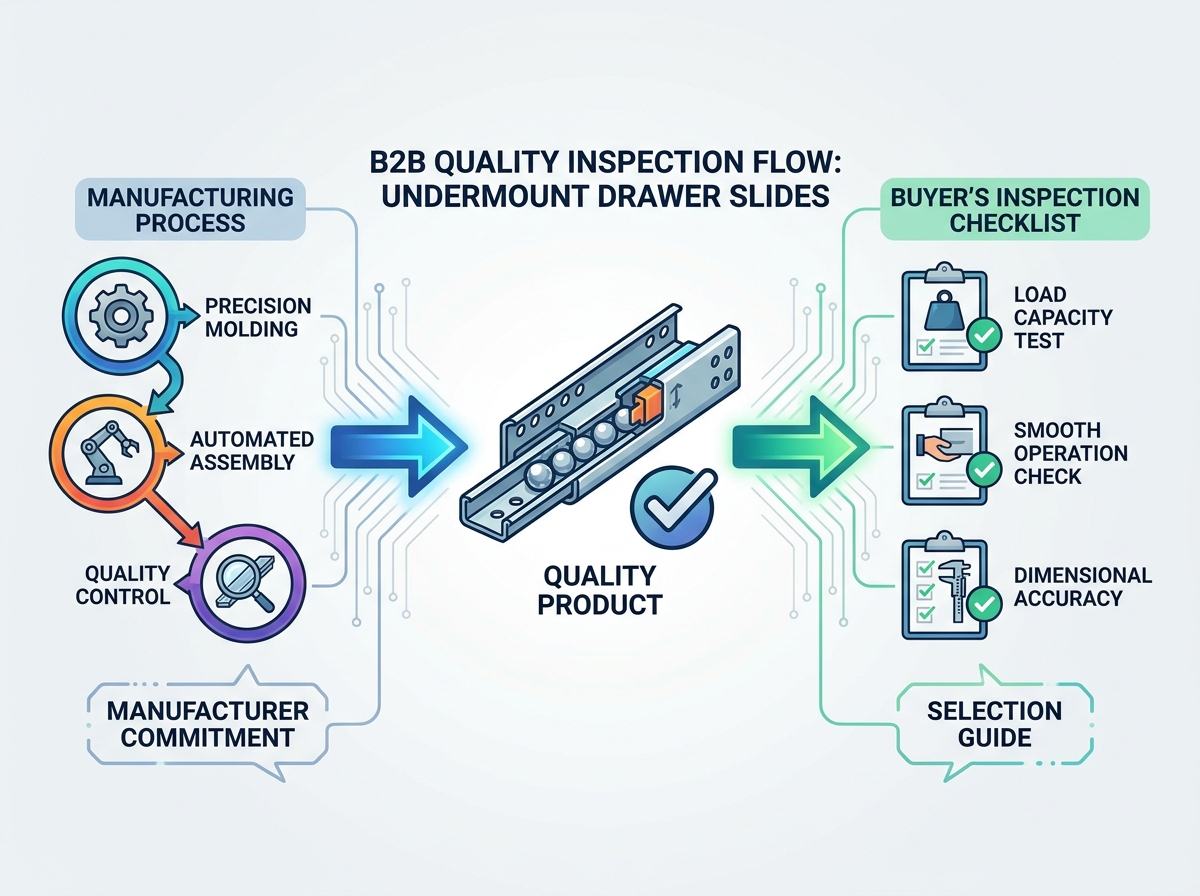
The method of fabrication directly influences the final quality of the hardware. Automated stamping and roll-forming reduce dimensional variance compared to manual fabrication. Progressive die stamping ensures that every mounting hole and structural bend is identical across thousands of units. Roll-forming machines shape the steel tracks with extreme precision, ensuring the ball bearings have a perfectly smooth channel to travel through. If the roll-forming dies are worn, the track will have microscopic waves, leading to a rough glide.
Automated riveting maintains the structural integrity of the slide chassis. Manual riveting often results in inconsistent pressure, leading to loose joints that fail under heavy loads. Understanding the drawer slide manufacturing process is essential for predicting batch consistency. Facilities that rely heavily on manual assembly for their soft-close mechanisms often suffer from high defect rates due to human error in damper alignment. A misaligned damper will cause the drawer to bounce back instead of closing softly.
A manufacturer's internal quality control protocols dictate the reliability of their output. ISO 9001 certifications and documented standard operating procedures are fundamental requirements. However, certifications alone are not enough. You must investigate their actual factory floor practices. Ask to see their inspection logs and defect tracking sheets.
Look for high batch testing frequency. A reliable undermount drawer slides manufacturer will pull samples from the production line hourly for cycle testing and dimensional checks using precision Go/No-Go gauges. Investigate their procedures for quarantining defective runs. If a batch fails a spot check, the facility must have strict protocols to isolate and destroy the defective units before they reach the packaging department. If they cannot explain their quarantine process, they likely ship defective units.
Long-term vendor reliability requires a demonstrated commitment to continuous improvement. Evaluate the manufacturer’s investment in research and development. Do they have proprietary testing facilities equipped with automated cycle-testing machines and salt spray chambers? Facilities that invest in their own testing infrastructure are generally more capable of maintaining strict quality standards and adapting to new engineering requirements.
Transparency signals are a major factor in vendor selection. A trustworthy partner will show a willingness to provide raw material sourcing documentation. They should also supply independent audit reports upon request. This level of furniture hardware quality commitment ensures that the materials used in your production run match the specifications of the initial golden sample. Vendors who hide their material sources often substitute cheaper steel during large production runs.
Selecting the correct hardware requires mapping cycle rating expectations to specific use cases. Standard residential applications typically require slides rated for 50,000 cycles. This rating ensures the hardware will outlast the typical lifespan of residential cabinetry under normal daily use. Using a lower-rated slide in a kitchen environment guarantees premature failure and customer complaints.
Heavy-duty commercial, medical, or laboratory applications demand much higher durability. These environments require slides rated for 100,000 or more cycles under full dynamic load. Using residential-grade hardware in a commercial setting is a massive liability. Consulting a comprehensive undermount drawer slide selection guide helps align the mechanical specifications with the intended environment, ensuring you do not under-spec or over-spec your hardware.
Undermount systems have strict clearance and notching requirements that dictate how the drawer box must be built. The drawer box construction prerequisites include exact bottom recess dimensions, typically around 1/2 inch (13mm). Rear notching depths must also be precise to accommodate the slide hooks. If the notch is too shallow, the drawer will not close flush with the cabinet face.
Side-wall thickness limitations are a critical compatibility factor. Most undermount slides are engineered specifically for either 1/2-inch or 5/8-inch drawer side materials. Using the wrong slide for your material thickness will prevent the drawer from fitting into the cabinet opening. The interior width of the drawer box must be calculated perfectly based on the slide's profile.
Drawer Side Thickness | Maximum Interior Width Deduction | Slide Compatibility Profile | Common Application |
|---|---|---|---|
1/2 inch (12-13mm) | 5/8 inch (16mm) | Standard Profile | Premium Residential Kitchens |
5/8 inch (16mm) | 3/8 inch (10mm) | Wide Profile | Commercial & Heavy Duty |
3/4 inch (19mm) | Requires Custom Routing | Specialty / Heavy Duty Profile | Architectural Millwork |
A manufacturer's adherence to tight slide tolerances prevents the need for custom woodworking adjustments on the assembly line. If the slide dimensions fluctuate, the drawer box will sit crooked, forcing assemblers to shim the hardware or rebuild the drawer. This destroys your labor efficiency.
Sourcing replacement hardware for large-scale facility upgrades requires careful system identification. You must identify existing metal glide systems accurately to ensure backward compatibility. Upgrading hundreds of hotel room dressers or hospital casework units is only efficient if the new hardware fits the existing drawer boxes without major modifications.
Measure the existing bottom recess, rear notch dimensions, and locking device hole patterns. Providing these exact measurements to your vendor ensures you receive hardware that requires minimal retrofitting labor. If the new slides require re-routing the drawer bottoms, the labor costs will quickly outweigh any savings on the hardware itself.
Procurement teams often focus entirely on the unit price of the hardware. This is a flawed approach. You must calculate the true cost of cheap hardware by comparing unit savings against the time lost adjusting poorly toleranced slides. Saving a few cents on a drawer slide is meaningless if your assembly team spends three extra minutes shimming and adjusting every single drawer to make it sit flush.
High-quality hardware with strict dimensional tolerances drops into place perfectly every time. This predictability allows assembly lines to run at maximum speed. When evaluating vendor quotes, factor in the expected installation time. Run a time-study on the assembly floor using samples from different vendors to see which hardware actually yields the best production throughput.
Procurement teams must carefully weigh the logistical realities of overseas manufacturing against domestic sourcing. Overseas production often provides access to massive manufacturing scale and advanced automated facilities. However, it introduces potential shipping delays, port congestion, and complex customs procedures. You must factor these delays into your production schedule.
Consistent lead times are critical for maintaining high-volume production schedules. A delayed hardware shipment halts the entire cabinet assembly line. To mitigate supply chain disruptions, establish vendor-managed inventory (VMI) or safety stock agreements with your manufacturer. These agreements require the vendor to hold a specific quantity of your required hardware in a local warehouse. This buffer stock protects your production line from unexpected transit delays or sudden spikes in your own manufacturing volume.
Standardizing drawer box dimensions across all product lines is the most effective way to accommodate specific undermount hardware requirements. Variations in drawer construction lead to installation errors. Ensure your engineering team creates strict dimensional blueprints that align perfectly with the slide manufacturer's specifications. Do not allow shop floor workers to deviate from these blueprints.
Train assembly teams thoroughly on specific locking device adjustments. Modern undermount systems often feature 4-way or 6-way adjustable locking devices. These allow for up/down, left/right, and in/out adjustments to perfectly align the drawer fronts. If workers do not understand how to use these adjustments, the final product will look sloppy, with uneven gaps between drawer fronts.
Evaluate the availability of manufacturer-supplied installation jigs, boring templates, and standardized tooling. Reputable vendors provide these tools to streamline the assembly process. Using standardized jigs reduces human error, ensuring that every mounting hole is drilled in the exact correct location. Freehand drilling is unacceptable in high-volume production.
Never commit to a bulk purchase order based solely on a visual inspection of a sales sample. Conduct a blind teardown and stress test of vendor samples first. Disassemble the slide to inspect the internal damper, spring mechanisms, and ball bearing cages. Look for excessive plastic flashing or uneven lubrication.
Drill out the rivets to separate the slide chassis and expose the internal carriage.
Inspect the ball bearing cage for material quality; steel or high-grade nylon is acceptable, cheap brittle plastic is not.
Examine the damper cylinder for any signs of fluid leakage or weak seals.
Test the tension spring by stretching it to its maximum limit and measuring its return rate.
Wipe down the tracks to check the quality and viscosity of the factory-applied grease.
Benchmark the prospective vendor's sample against established top-tier industry brands. Compare the smoothness of the glide, the amount of deflection at full extension, and the acoustic profile during the soft-close engagement. This side-by-side comparison establishes a definitive baseline for acceptable quality and exposes inferior engineering.
Reliable drawer slide performance is a product of strict engineering and uncompromising manufacturing standards. It does not come from glossy marketing claims or superficial visual inspections. The structural integrity of your furniture depends entirely on the consistency of the hardware hidden beneath the drawer box. Prioritize manufacturers who provide transparent testing data and utilize automated production lines. They must demonstrate a verifiable commitment to quality control at every stage of fabrication. By demanding rigorous documentation, you protect your production efficiency and your brand reputation.
Request technical specification sheets and independent cycle test reports from your current or prospective vendors immediately.
Demand raw material certifications to verify steel gauges and zinc plating thickness for all incoming batches.
Order a small pilot batch of 50 to 100 units to run a live time-study on your assembly floor.
Standardize your internal testing protocols to ensure all incoming hardware meets your exact application requirements before it reaches the assembly line.
A: A reputable manufacturer must hold ISO 9001 certification for quality management systems. Furthermore, their products should be tested to meet or exceed ANSI/BIFMA or KCMA testing standards. These certifications ensure strict adherence to product durability, load capacity, and consistent manufacturing processes.
A: Automated assembly ensures the precise alignment of the damper and spring mechanisms. Manual assembly often introduces slight variations in component placement. These minute inconsistencies cause uneven tension, leading to premature failure, rattling, or a drawer that fails to pull completely closed.
A: Commercial applications typically require hardware rated for 75,000 to 100,000 cycles under full dynamic load. This high rating ensures the slides can withstand the rigorous, continuous use found in medical facilities, offices, and hospitality environments without degrading.
A: Always request independent laboratory test reports from the vendor. These documents detail the dynamic load performance, cycle testing results, and the maximum deflection measured at full extension. Do not rely solely on internal marketing documents for load ratings.
A: Undermount systems are concealed beneath the drawer. This requires precise bottom clearances, specific rear notching, and exact side-wall thicknesses to accommodate the metal chassis and locking mechanisms. Side-mount slides are much simpler and do not require these strict spatial modifications.
A: Heavy-duty applications require 1.5mm to 2.0mm cold-rolled steel. This thickness prevents the chassis from warping or deflecting under heavy dynamic loads. Thinner steel gauges will bend, causing the internal bearings to bind and the slide to fail prematurely.
A: Yes, reputable manufacturers supply specialized boring templates, installation jigs, and detailed spatial diagrams. These tools ensure rapid, repeatable assembly line installation, minimizing human error and guaranteeing that locking devices and mounting brackets align perfectly every time.


