

close
Choose Your Site
Global
Social Media
Views: 0 Author: Site Editor Publish Time: 2026-08-24 Origin: Site


Vague hardware specifications during the original equipment manufacturing sourcing process create immediate financial and operational friction. When design requirements lack precise engineering tolerances, manufacturers face delayed production timelines, inaccurate prototype quoting, and unacceptable post-assembly failure rates. Transitioning from prototype furniture designs to mass production requires translating aesthetic design intent into strict, verifiable manufacturing data. Off-the-shelf hardware frequently fails to meet specific internal cabinet depths, dynamic load requirements, or the rapid assembly line efficiencies demanded by high-volume production facilities.
Establishing a systematic framework for defining technical requirements before submitting a Request for Quote to a hardware manufacturer solves this. This proactive engineering approach ensures exact fit and reliable mechanical performance. By detailing every dimensional tolerance, load capacity, and actuation mechanism upfront, procurement and engineering teams eliminate guesswork, streamline the prototyping phase, and secure hardware that integrates flawlessly into the final furniture assembly.
Precise dimensional tolerances—specifically drawer box material thickness, construction methods, and internal cabinet depth—dictate the feasibility of custom undermount hardware.
Defining dynamic load capacity and cycle-testing requirements upfront prevents premature mechanical failure and warranty claims.
Specifying exact actuation features (e.g., synchronized soft-close, push-to-open) standardizes the user experience across your entire undermount drawer slide product range.
Requiring documented furniture hardware certifications (like ANSI/BIFMA or KCMA) is non-negotiable for commercial and high-end residential compliance.
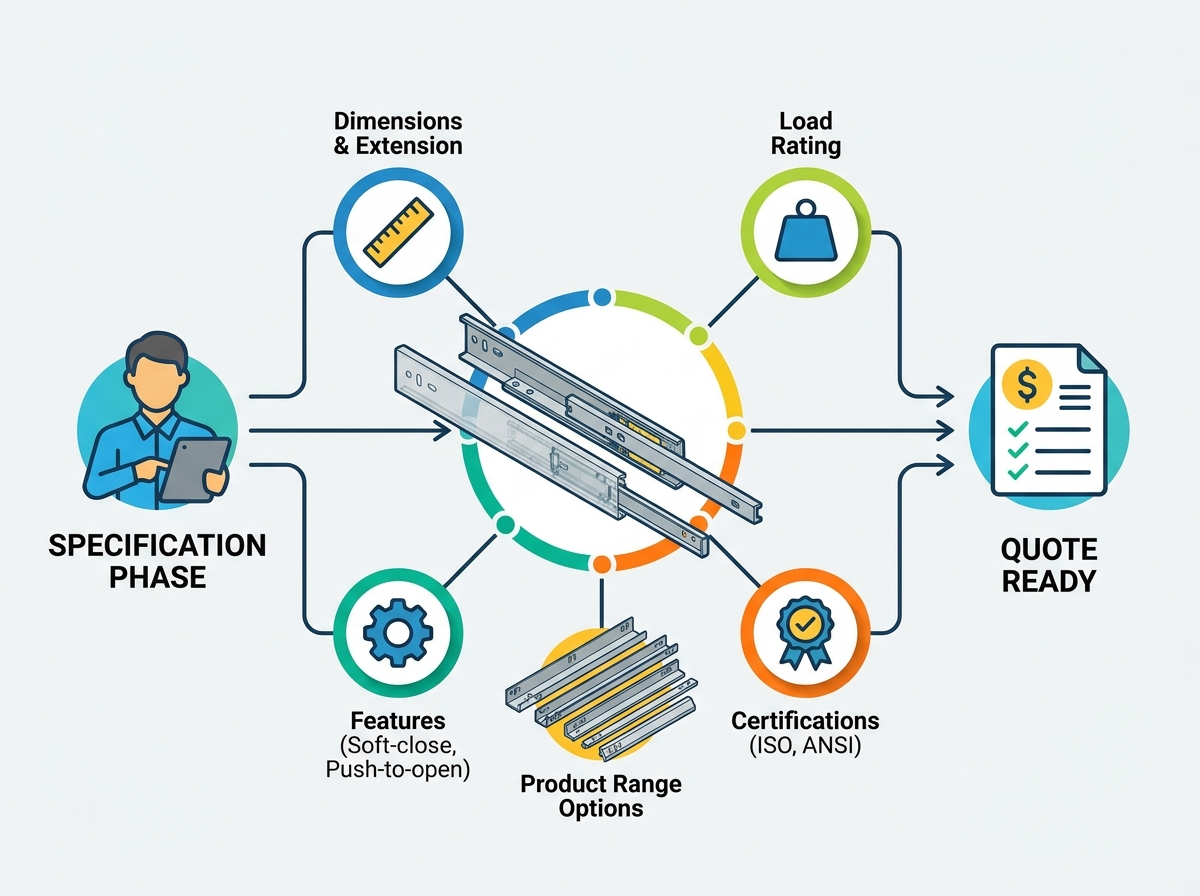
The market shift toward premium, concealed hardware for a cleaner aesthetic inherently demands much tighter manufacturing tolerances than traditional visible side-mount slides. Side-mount hardware allows for generous side-to-side clearance forgiveness. You can often get away with a 1/16-inch variance in drawer box width. Concealed hardware operates strictly within the sub-front cavity and relies on precise bottom-mounting configurations. This fundamental design difference means that any deviation in drawer box construction or cabinet squaring directly impacts the slide's ability to engage, operate smoothly, and lock securely.
Under-specifying hardware in a Request for Quote introduces severe risks to the manufacturing pipeline. Supplier misinterpretation of vague dimensions leads to the production of incompatible prototypes. We often see hidden tooling costs surface later in the process when custom hole patterns or specialized locking devices are suddenly required to correct misalignment. When specifications lack detail, manufacturers substitute standard components that do not align with the specific structural demands of the furniture. This leads to compromised structural integrity and increased warranty claims from end-users.
A successful hardware sourcing outcome is defined by predictable unit costs, zero assembly line bottlenecks, and zero field failures. Achieving this requires engineering teams to provide suppliers with comprehensive technical data. Standard SKUs frequently fall short in specialized applications. Non-standard cabinet depths, specific gauge steel requirements for heavy-duty applications, and proprietary mounting brackets necessitate the engineering of custom undermount drawer slides. Customization ensures the hardware matches the exact physical constraints and performance expectations of the furniture line. You stop forcing the furniture design to adapt to standard hardware limitations.
The critical relationship between the slide and the drawer side thickness dictates the entire specification process. Concealed slides are engineered to accommodate specific material thicknesses. You typically see 1/2-inch, 5/8-inch, or 3/4-inch stock on the shop floor. The slide profile must nest perfectly within the bottom recess of the drawer. If a slide designed for 5/8-inch material is paired with a 3/4-inch drawer side, the hardware will bind against the cabinet interior. This causes severe friction and eventual mechanical failure.
When building dovetail drawers, the side material thickness dictates the exact width of the bottom panel. If you are running a high-production CNC router, programming the exact sub-front clearance is non-negotiable. The standard sub-front clearance is usually 1/2-inch, but heavy-duty slides might require 5/8-inch. If your CNC operator cuts the groove for the bottom panel too low, the slide will bottom out. If they cut it too high, the locking devices will not snap into the pre-drilled holes on the drawer bottom. We see this mistake constantly on the shop floor. It leads to thousands of dollars in scrapped drawer boxes. You must align your wood machining tolerances with the steel tolerances of the slide.
Drawer box construction methods directly impact the required slide specifications. Dovetail joints and doweled construction require different internal width calculations relative to the cabinet opening. The exact measurement from the outside of the drawer box to the inside of the cabinet dictates the necessary side clearance. Establishing precise undermount drawer slide specifications upfront eliminates costly assembly workarounds. A common, labor-intensive workaround involves routing the bottom edges of 3/4-inch drawer sides to fit standard 5/8-inch slides. This extra CNC or router step slows down production and weakens the drawer structure. Specifying the correct slide profile eliminates this step entirely.
Bottom recess dimensions, known as sub-front clearance, must be specified to ensure the locking mechanisms sit flush and engage properly. The distance from the bottom edge of the drawer side to the underside of the drawer bottom panel must match the height of the slide runner. If this recess is too shallow, the drawer will sit too high in the cabinet opening. If it is too deep, the locking clips will fail to engage the runner securely.
Specification requirements for partial extension, full extension, and over-travel slides depend entirely on the end-user application. Standard bathroom vanities often utilize partial extension slides due to plumbing interference at the rear of the cabinet. High-end kitchen cabinetry demands full extension slides for complete access to the drawer interior. Deep file cabinets and commercial storage units require over-travel slides. These allow the drawer box to extend completely past the cabinet face frame for unobstructed access to files at the very back.
Specifying the exact runner length versus the nominal drawer length is essential for maximizing internal storage without interfering with the cabinet back panel. Strict front-to-back depth matching ensures the slide operates within its engineered travel limits. The runner length must accommodate the depth of the cabinet while leaving sufficient clearance for the back panel and any rear mounting brackets. Over-specifying runner length results in rear-panel collisions. Under-specifying reduces the available drawer box depth and wastes valuable storage space.
Nominal Drawer Length | Minimum Internal Cabinet Depth | Recommended Slide Travel | Application Example |
|---|---|---|---|
12 inches (305mm) | 12.75 inches | Full Extension | Shallow vanity or desk drawer |
15 inches (381mm) | 15.75 inches | Full Extension | Standard kitchen top drawer |
18 inches (457mm) | 18.75 inches | Over-Travel | Deep pot and pan storage |
21 inches (533mm) | 21.75 inches | Full Extension | Standard base cabinet drawer |
24 inches (610mm) | 24.75 inches | Over-Travel | Commercial lateral file cabinet |
Smooth operation requires strict adherence to side-to-side and top-to-bottom clearance specifications. Concealed slides typically require precise side clearances. You are often leaving only millimeters of tolerance between the drawer side and the cabinet interior. Top-to-bottom clearances must account for the height of the drawer front, the required gap between drawer fronts, and the physical height of the slide mechanism beneath the drawer box.
Frameless European-style cabinets require different clearance calculations than traditional face-frame cabinets. In a frameless cabinet, the slide mounts directly to the cabinet side panel. You must account for hinge plate interference if the drawer sits behind a door. In face-frame construction, you often need rear mounting brackets to support the back of the slide. These brackets require at least 1 inch of depth adjustment to account for out-of-square cabinets. Specifying the correct mounting method in your RFQ prevents installers from having to shim slides on the job site. Shimming is a massive waste of labor and compromises the load capacity of the hardware.
Specifying adjustment capabilities mitigates slight manufacturing variances in the wooden components. Wood is a dynamic material subject to expansion, contraction, and minor machining deviations. Utilizing 3D or 4D locking devices provides essential up/down, left/right, and tilt adjustments. These adjustment clips allow assembly line workers and field installers to perfectly align drawer fronts without removing the drawer or repositioning the slide mounting screws. This drastically reduces installation time and improves the final aesthetic.
Differentiating between static load and dynamic load is a fundamental engineering requirement. Static load refers to the weight capacity of the hardware when the drawer is entirely at rest and closed. Dynamic load represents the weight capacity during operation. It accounts for the kinetic energy generated when a fully loaded drawer is pulled open or slammed shut. The dynamic forces exerted on the ball bearings and steel profiles are significantly higher than static resting weight.
A framework for specifying load classes must align with the intended furniture application. Residential kitchen drawers holding lightweight utensils may only require a 75-pound dynamic load rating. Deep drawers designed for heavy pots and pans demand a 100-pound dynamic rating. Commercial office furniture, particularly lateral file cabinets, requires heavy-duty slides rated for 150 pounds or more. Specifying the correct dynamic load class prevents runner deflection, bearing failure, and cabinet racking under heavy daily use.
Expected lifecycle metrics must be explicitly stated in the RFQ document. Cycle testing simulates the lifespan of the hardware by repeatedly opening and closing a fully loaded drawer. Standard residential hardware is typically tested to 50,000 cycles. This represents years of normal household use. Commercial and institutional furniture requires hardware tested to 100,000 cycles or more to withstand rigorous daily operation.
A 50,000-cycle test involves a machine opening and closing the drawer at a set speed, usually 10 to 15 cycles per minute. The drawer is loaded with steel weights to simulate the maximum dynamic load. If a slide is rated for 100 pounds, it must complete all 50,000 cycles without the ball bearings falling out, the steel profiles bending, or the soft-close mechanism failing. We look for specific failure points during testing. The most common failure is the dampening cylinder leaking hydraulic fluid after 30,000 cycles. When specifying hardware, ask the manufacturer for the full testing report, not just a pass/fail certificate. You need to know exactly how the hardware performed at the end of the test.
Material gauge, ball bearing quality, and synthetic roller materials directly impact cycle life under maximum dynamic load. Thicker cold-rolled steel profiles resist bending and torsion during heavy use. High-carbon steel ball bearings provide smoother operation and resist deformation better than standard bearings. Synthetic rollers and dampening cylinders must be manufactured from durable polymers capable of withstanding friction and temperature variations without degrading over the specified cycle lifespan.
Soft-close dampening mechanisms require precise specifications regarding stroke length and pull-force resistance. The dampening cylinder must catch the drawer at a specific distance from the cabinet face and pull it silently shut. Custom spring tensions must be specified based on the mass of the drawer. A lightweight vanity drawer requires a lower spring tension to prevent the user from having to yank the drawer open. A heavy-duty file drawer requires a robust spring to ensure the heavy mass is pulled completely closed.
Push-to-open touch release systems are essential for handle-less cabinetry designs. Specifications must outline trigger sensitivity and ejection distance. The mechanism must actuate with a light, deliberate press but resist false triggers from accidental bumps. The ejection distance must push the drawer out far enough for the user to comfortably grip the drawer front. Synchronized runners become necessary in wide applications. Rack-and-pinion synchronization prevents drawer racking. It ensures that pressing on one side of a wide drawer front actuates the mechanism evenly across both slides.
Actuation Type | Primary Application | Key Specification Metric | Common Shop Floor Challenge |
|---|---|---|---|
Standard Soft-Close | Kitchen and Bath Cabinetry | Dampening Stroke Length (e.g., 2 inches) | Spring tension too high for lightweight drawers |
Push-to-Open | Handle-less Modern Furniture | Ejection Distance (e.g., 1.5 inches) | False triggers from accidental bumps |
Synchronized Push-to-Open | Wide Lateral File Drawers | Rack-and-Pinion Rod Length | Cutting synchronization rods to exact internal width |
Self-Close (Non-Dampened) | Utility and Shop Storage | Closing Force Profile | Harsh impact noise upon closing |
Specifying a cohesive undermount drawer slide product range from a single manufacturer provides a significant strategic advantage. Standardization ensures consistent mounting hole patterns across different furniture lines. This consistency reduces CNC programming variations. It minimizes the need for different installation jigs on the assembly line and simplifies inventory management. A unified product range allows manufacturers to scale production efficiently while maintaining a consistent user experience across all cabinetry collections.
The base material and required thickness dictate the structural integrity of the slide. Cold-rolled steel is the industry standard for concealed hardware. It offers superior tensile strength and a smooth surface finish essential for ball bearing operation. The gauge of the steel must be specified relative to the dynamic load requirements. Heavy-duty applications require thicker steel gauges to prevent the runner profiles from flexing under weight.
The thickness of the cold-rolled steel is measured in millimeters. Standard residential slides use 1.0mm or 1.2mm steel for the inner, middle, and outer profiles. Heavy-duty commercial slides require 1.5mm or even 2.0mm steel to prevent deflection. Deflection is the downward bowing of the drawer when fully extended. If a slide deflects too much, the drawer front will hit the drawer below it when closing. You must specify the maximum allowable deflection in your RFQ. For example, you might specify a maximum deflection of 1/16-inch under a 100-pound load at full extension. This forces the manufacturer to use the correct steel gauge.
Finish specifications must align with the end environment of the furniture. Zinc plating provides standard corrosion resistance suitable for most climate-controlled residential and commercial interiors. Galvanized finishes or specialized electroplating processes offer enhanced protection against oxidation and wear. This ensures the slide maintains its structural integrity and smooth operation over its intended lifespan.
High-humidity or specialized environments demand rigorous specification guidelines. Bathroom vanities, marine interiors, and laboratory furniture are exposed to moisture, chemical vapors, and fluctuating temperatures. Standard zinc plating will degrade rapidly in these conditions. Specifications for these environments must include salt-spray testing hour requirements. We often demand 48 to 96 hours of salt-spray resistance without red rust formation. Stainless steel components or advanced polymer coatings may be required to ensure long-term durability in highly corrosive settings.
Requesting proof of ANSI/BIFMA compliance is mandatory for commercial office furniture applications. BIFMA standards dictate rigorous testing protocols for load capacity, cycle life, and out-stop impact resistance. Hardware that passes these tests guarantees a level of safety and durability required by commercial procurement contracts. Kitchen cabinetry manufacturers must rely on KCMA testing data. KCMA certifications ensure the hardware can withstand the specific operational stresses of kitchen environments, including heavy loads and frequent use.
Specifying that the manufacturing facility holds ISO 9001 certification mitigates quality control risks during mass production. ISO 9001 ensures the supplier maintains strict quality management systems. This results in consistent batch-to-batch manufacturing tolerances. Environmental compliance documentation, such as RoHS and REACH, is necessary for hardware finishes and plastics. These directives restrict the use of hazardous substances in manufacturing. Securing documented furniture hardware certifications protects the manufacturer from liability and ensures market access.
A comprehensive Request for Quote document eliminates ambiguity and forces suppliers to provide accurate, actionable data. Structuring the RFQ correctly ensures all engineering and procurement requirements are addressed before prototype production begins. The document must serve as a strict technical baseline for evaluating supplier capabilities.
Do not rely on generic emails or verbal conversations when requesting quotes. Build a standardized spreadsheet that lists every single technical requirement. Include columns for your required specification, the supplier's proposed specification, and any deviations. This makes it easy to compare quotes from multiple manufacturers side-by-side. Always include a section for packaging requirements. Do you need the slides bulk-packed in boxes of 10 pairs for the assembly line? Or do you need them individually poly-bagged with screws and instructions for flat-pack furniture? Packaging dictates a significant portion of the final unit cost and affects how quickly your workers can unpack and install the hardware.
Follow these exact steps to build a bulletproof RFQ:
Document exact drawer box dimensions, construction method, and material thickness.
Measure and list the internal cabinet depth and required slide travel.
Calculate the dynamic load rating and state the cycle requirements.
Define required actuation features like soft-close or push-to-open.
List required furniture hardware certifications based on your market.
Specify requirements for assembly jigs or installation templates.
Provide estimated annual volume and delivery schedules.
Request engineering drawings (CAD/STEP files) and physical prototypes.
Precise, engineering-level specifications are the only mechanism to secure accurate quotes and reliable performance for original equipment manufacturer undermount slides. Vague requirements lead to incompatible prototypes, assembly line bottlenecks, and eventual field failures. By defining exact dimensional tolerances, dynamic load capacities, and actuation mechanics upfront, manufacturers ensure the hardware integrates seamlessly into the final product.
Procurement teams must shortlist suppliers who respond to the RFQ with detailed technical data sheets, transparent testing reports, and a willingness to provide custom engineering support. A supplier's ability to provide CAD files and physical prototypes that match the exact specifications is a strong indicator of their manufacturing competence and quality control standards.
Audit your current hardware specifications against your actual drawer box construction methods.
Develop a standardized RFQ template that includes all dynamic load and cycle testing requirements.
Request CAD/STEP files from shortlisted suppliers to verify cabinet clearance tolerances digitally before ordering physical prototypes.
Consult with a specialized hardware manufacturer to review custom tooling options for non-standard cabinet depths.
A: Standard setbacks typically range from 3/32-inch to 1/8-inch from the front edge of the cabinet. Custom applications require specific CNC programming based on the manufacturer's spec sheet to ensure drawer fronts align perfectly flush with the cabinet face frame or inset requirements.
A: No, unless you route the bottom edges of the 3/4-inch material to 5/8-inch thickness. This workaround compromises structural integrity and wastes assembly line labor. Manufacturers must specify slides engineered specifically for 3/4-inch material to ensure a proper fit without additional machining.
A: Match the nominal slide length to the internal cabinet depth while factoring in back-panel clearance and the space required for front locking devices. The slide runner must be slightly shorter than the internal depth to prevent rear-panel collisions during installation and operation.
A: Static load is the stationary weight capacity when the drawer is closed and at rest. Dynamic load is the operational weight capacity during movement, accounting for kinetic forces. Manufacturers must always specify dynamic load to ensure the hardware survives real-world daily use.
A: BIFMA ensures the hardware has passed rigorous, standardized cycle and load testing. This certification proves the slides can withstand heavy commercial use. It is legally and commercially required to win most commercial office furniture contracts and mitigate liability.


