

close
Choose Your Site
Global
Social Media
Views: 0 Author: Site Editor Publish Time: 2026-08-28 Origin: Site


The industry shift toward seamless, minimalist cabinetry design has made hardware visibility a primary aesthetic and functional concern for custom builds. Clients expect clean lines and uninterrupted wood grain when they open a drawer. Achieving this look requires moving mechanical components out of sight. This creates a core structural problem for cabinetmakers and installers. You must balance the visual demand for hidden hardware with the strict dimensional tolerances, load requirements, and clearance constraints of modern cabinetry.
Every cabinet environment presents unique challenges. Kitchens demand high load capacities for heavy cookware. Bathrooms require moisture resistance and complex plumbing clearances. Office casework needs deep extension capabilities for heavy files. You need to know how to evaluate, specify, and implement undermount hardware across these different cabinet environments without compromising structural integrity, project timelines, or the final fit and finish.
Concealed undermount slides require precise drawer box construction, specifically regarding side material thickness (typically 1/2" to 5/8") and bottom recess depth.
The application environment (kitchen, bath, or office) directly dictates the required load capacity, slide length, and extension type.
Soft-close full-extension undermount slides offer the highest standard of user experience, but demand exact depth planning and cabinet clearance.
Implementation risks center around incorrect drawer sizing, failure to account for face-frame vs. frameless variations, and improper use of rear mounting brackets.
Retrofitting existing cabinets with undermount hardware generally requires fabricating entirely new drawer boxes due to strict width and bottom-clearance differences compared to side-mount systems.
Eliminating side-mounted hardware fundamentally changes the visual impact of an open drawer. Traditional side-mount slides interrupt the visual flow with metallic tracks, grease, and visible ball bearings. Moving the slide mechanism entirely beneath the drawer box allows the craftsmanship to take center stage. High-quality materials, such as solid hard maple or Baltic birch plywood, remain fully visible. Joinery techniques like half-blind dovetails or box joints become prominent design features rather than hidden structural necessities.
Beyond aesthetics, bottom-mounted hardware provides a distinct mechanical advantage. The slides support the drawer box directly from underneath, aligning the load-bearing mechanism with the center of gravity. This bottom-support strength prevents racking and sagging, particularly in wider, heavier drawers. The structural load transfers downward into the slide carriage rather than pulling laterally against the cabinet sides. This configuration ensures a rigid, stable motion path even when the drawer is fully loaded and extended past the cabinet face.
Understanding the mechanical differences between slide types helps justify the specification of concealed undermount slides for premium projects. Traditional side-mount ball-bearing slides carry the load on the vertical axis. They require a standard 1/2-inch clearance on each side of the drawer box. While durable, side-mounts expose the hardware and limit the maximum internal width of the drawer.
Legacy center-mount slides operate on a single wooden or metal track running down the middle of the drawer bottom. They fall short in weight capacity and lateral stability. Center-mounts typically handle only light loads and often suffer from side-to-side wobble during operation. Modern dual-undermount systems solve both issues. They provide the hidden profile of a center-mount while exceeding the lateral stability and load capacity of side-mounts.
Hardware Type | Visual Profile | Load Distribution & Stability | Standard Weight Capacity | Clearance Requirements |
|---|---|---|---|---|
Concealed Undermount | Completely hidden beneath the drawer box | Bottom support, excellent lateral stability | 75 lbs to 150+ lbs | Exact outside width deductions, 1/2" bottom recess |
Side-Mount Ball-Bearing | Highly visible on both sides of the drawer | Side shear load, good stability | 50 lbs to 100+ lbs | 1/2" side clearance per side (1" total) |
Legacy Center-Mount | Hidden underneath, single track | Center support, poor lateral stability | 20 lbs to 35 lbs | Minimal side clearance, requires bottom track space |
Specifying bottom-mounted hardware introduces strict dimensional requirements. The drawer box outside width must be exactly sized to the slide width and the cabinet opening. If the drawer box is even 1/32-inch too wide or too narrow, the locking clips will not engage properly, and the slide mechanism will bind. This demands high precision during the milling and assembly phases.
You must weigh the upfront hardware investment and increased fabrication time against the long-term value of the installation. Bottom-mounted systems require precise bottom panel recessing and exact side material thickness. The resulting smoother operation, integrated soft-close mechanics, and premium positioning of the finished cabinetry justify the initial effort. The precision required during fabrication ultimately reduces callbacks related to sagging drawers or misaligned gaps.
Kitchen environments test the physical limits of cabinet hardware. You must differentiate specifications between deep drawers used for pots, pans, and small appliances, and standard top drawers used for cutlery and utensils. Deep lower drawers face immense static and dynamic loads. A drawer full of cast-iron cookware requires heavy-duty slide mechanisms designed to handle significant weight without deflecting or failing over time.
When selecting hardware for these zones, evaluate dynamic load capacities. Standard kitchen drawers operate reliably on slides rated for 75 to 90 pounds. Heavy-duty applications demand slides rated for 100 to 150+ pounds. Always verify that the chosen hardware meets BHMA (Builders Hardware Manufacturers Association) or KCMA (Kitchen Cabinet Manufacturers Association) cycle testing standards. These certifications ensure the slides will withstand decades of daily opening and closing under full load conditions.
Bathroom vanities present a completely different set of structural challenges. You must navigate complex plumbing clearances, including P-traps and water supply lines. This often requires specifying shortened slide lengths, such as 12-inch or 15-inch models, to prevent the drawer box from hitting the plumbing. In many cases, you will need to fabricate custom U-shaped drawer boxes that wrap around the pipes while still utilizing standard bottom-mounted hardware.
Moisture is the secondary challenge in bathroom undermount slide applications. High-humidity environments accelerate corrosion on exposed steel components. Evaluate the material and coating of the slide carriage. Look for heavy zinc plating or specialized anti-corrosion finishes to protect the ball bearings and dampening cylinders from rust. Proper ventilation within the vanity cabinet also helps extend the lifespan of the hardware.
Commercial casework and home offices require hardware built for continuous use and heavy paper loads. A lateral file drawer filled with documents exerts massive downward pressure on the slide carriage. You must specify robust hardware to prevent the drawer box from dropping or binding when fully opened.
This environment necessitates soft-close full-extension undermount slides for deep file storage. Full extension allows users to easily read and retrieve files at the very back of the drawer. For maximum accessibility, evaluate over-travel options. Over-travel slides extend the drawer box an extra inch or more past the cabinet face, providing complete, unobstructed access to the entire interior volume.
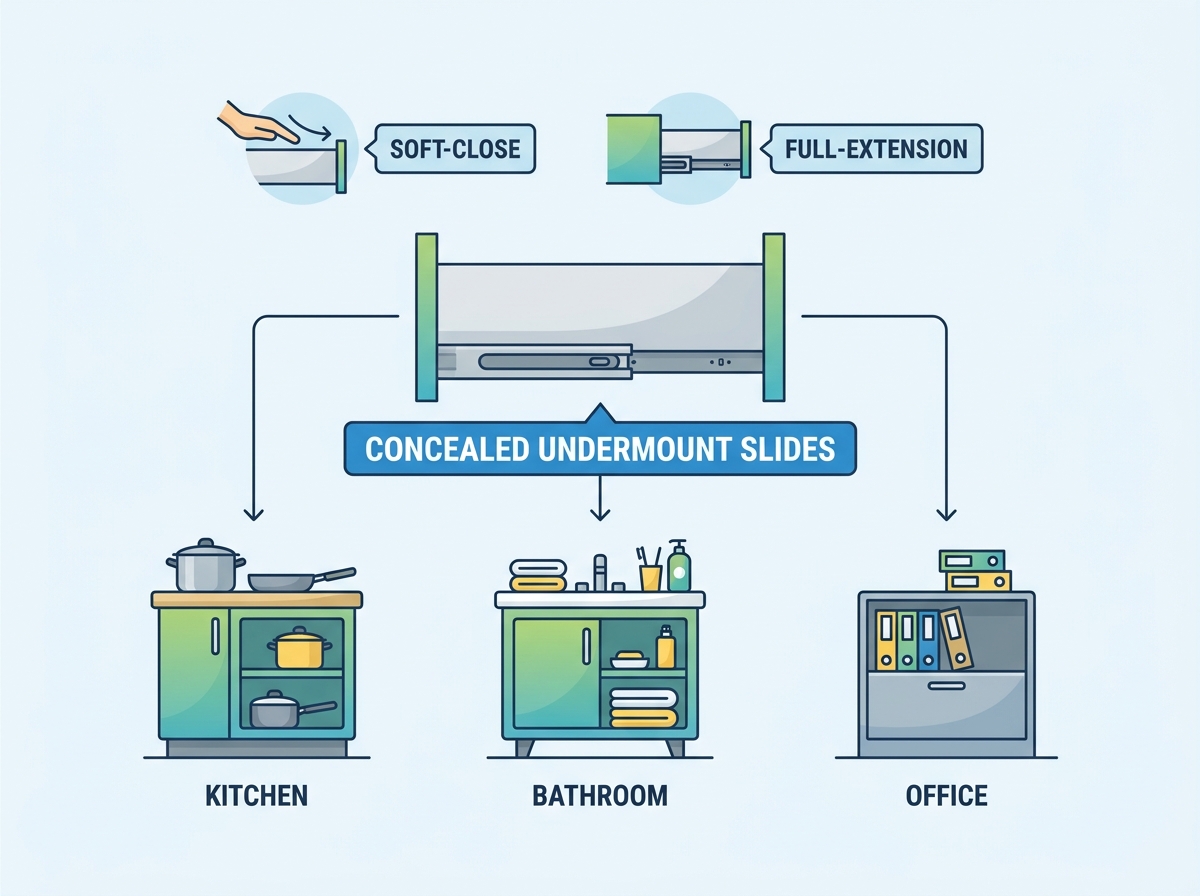
The extension type directly impacts how users interact with the cabinet. Partial extension slides typically expose only three-quarters of the drawer box. While suitable for shallow depths or budget-conscious projects, they restrict access to the rear of the drawer. Full extension has become the baseline expectation for premium cabinetry. It brings the back of the drawer box flush with the cabinet face.
Over-travel mechanisms take this a step further. They pull the drawer completely clear of the countertop overhang. This is particularly useful in kitchen environments where thick stone countertops protrude past the cabinet face, potentially blocking access to the rear of the top drawers. Selecting the right extension type maximizes usable drawer depth and improves overall ergonomics.
Motion technology dictates the tactile feel of the cabinetry. Soft-close mechanisms catch the drawer during the final inches of travel and pull it shut silently. You must evaluate the internal components of these mechanisms. Fluid dampening cylinders provide a smoother, more consistent closing action compared to mechanical spring systems. Fluid dampers adjust dynamically to the closing force, preventing slamming regardless of how hard the drawer is pushed.
Push-to-open systems cater to handle-less cabinet designs. A touch release mechanism ejects the drawer forward when the user presses on the drawer front. While visually striking, push-to-open systems introduce trade-offs in installation complexity. They require exact depth calibration to ensure the trigger mechanism engages and releases reliably. Some advanced slides combine both push-to-open and soft-close technologies, requiring meticulous installation to balance the ejection spring against the dampening cylinder.
Front locking clips are the critical connection point between the wooden drawer box and the metal slide mechanism. These clips secure the drawer in place and allow for quick removal without tools. The quality of the locking clip directly affects the rigidity of the drawer.
Micro-adjustability is essential for achieving perfect reveal lines across a bank of drawers. Wood expands, contracts, and occasionally warps. Cabinets may settle out of plumb. You need the ability to fine-tune the drawer fronts after installation. Standard clips offer basic height adjustment. Advanced systems provide 4-way or 6-way adjustment capabilities. This allows you to manipulate height, side-to-side positioning, and tilt or depth. Six-way adjustability ensures perfectly uniform gaps between drawer fronts, which is the hallmark of professional installation.
Not all bottom-mounted slides perform equally. Evaluate slide quality based on the physical construction of the carriage. Thicker steel gauges resist deflection under heavy loads. Synthetic roller durability determines how smoothly the drawer glides over time. Cheap plastic rollers will flatten or crack, leading to a bumpy motion path.
Check the steel gauge of the main carriage. 16-gauge steel offers significantly more rigidity than thinner 14-gauge alternatives.
Inspect the ball bearing or synthetic roller tracks for smooth, unhindered movement before installation.
Verify the dampening cylinder is securely housed and does not leak hydraulic fluid under pressure.
Test the locking clip springs to ensure they provide a firm, positive engagement with the slide hook.
Investing in reputable hardware ecosystems ensures consistent performance. Premium manufacturers maintain tight manufacturing tolerances, meaning every slide performs exactly like the last. Sticking to a recognized ecosystem also guarantees warranty support and the availability of specialized installation jigs. These jigs drastically speed up the process of pre-drilling mounting holes and installing locking clips with pinpoint accuracy.
Following a strict undermount drawer slides guide is mandatory for successful implementation. The hardware dictates the exact dimensions and material thicknesses of the drawer box. Standard locking clips require a maximum side material thickness of 5/8-inch. If you use 3/4-inch material for the drawer sides, standard clips will not fit, and the drawer will not engage the slide carriage. You must source specialized clips designed specifically for 3/4-inch material.
The bottom recess is another non-negotiable requirement. You must build the drawer box with a recessed bottom panel, typically set 1/2-inch up from the bottom edge of the side panels. This recess hides the slide mechanism and provides the necessary clearance for the locking clips and rear hooks to engage. Failure to mill this exact recess will render the hardware useless.
Drawer Side Thickness | Required Outside Width Deduction (from opening) | Locking Clip Compatibility |
|---|---|---|
1/2 inch (13mm) | Deduct 5/8 inch total | Standard Clips |
5/8 inch (16mm) | Deduct 3/8 inch total | Standard Clips |
3/4 inch (19mm) | Deduct 7/16 inch total | Specialized 3/4" Clips Required |
Matching the slide length to the cabinet depth requires precise calculation. Standard slides require at least an inch of rear clearance behind the drawer box. For example, you cannot install a 21-inch slide in a cabinet with an exact 21-inch internal depth. A 21-inch slide typically requires a minimum internal cabinet depth of 21-7/8 inches to 22 inches. Standard kitchen base cabinets are 24 inches deep, comfortably accommodating 21-inch slides.
Custom and oversized applications require careful planning. When specifying slide lengths for 26-inch deep custom kitchen islands, you should utilize 24-inch slides to maximize usable drawer space, provided the internal clearance allows for it.
You must also differentiate mounting protocols between cabinet styles. Frameless (Euro-style) cabinets allow the slides to mount directly to the flat interior side panels using the 32mm system hole spacing. Face-frame cabinets require the slides to be mounted to the front frame and supported at the rear, or they require internal blocking to build the sides flush with the frame opening.
Rear mounting brackets are primarily used in face-frame applications where the cabinet lacks solid interior side panels. The front of the slide screws into the face frame, and the rear bracket attaches to the cabinet back. This creates a bridge for the slide to rest on. You must ensure the rear brackets are perfectly level and aligned with the front mounting points to prevent the slides from twisting.
Ultra-wide drawers introduce the risk of racking, where one side of the drawer pulls forward faster than the other. To mitigate racking in wide applications, implement lateral synchronization rods. These metal rods connect the left and right slide mechanisms, forcing them to move in unison. Proper internal blocking and side spacers also help maintain strict parallel alignment between the slides.
Clients often request upgrades from old side-mount hardware to modern hidden systems. You must explain the structural realities of this retrofit. It is rarely a simple hardware swap. Existing drawer boxes built for side-mount slides are almost never compatible with bottom-mounted systems.
Side-mount drawers lack the required 1/2-inch bottom recess. Furthermore, the outside width of a side-mount drawer is typically 1 inch narrower than the cabinet opening (allowing 1/2-inch per side). Bottom-mounted systems require specific outside-width deductions based on the drawer side thickness (often requiring the drawer to be wider than a side-mount equivalent). Consequently, retrofitting generally requires fabricating entirely new drawer boxes to match the strict tolerances of the new hardware.
Concealed undermount slides are the definitive standard for premium cabinetry, provided the fabrication team can adhere to the strict milling and clearance tolerances. They offer unmatched aesthetic appeal, superior load distribution, and advanced motion technologies that elevate the user experience. Success depends entirely on precise execution during the planning and build phases. Base your final hardware specification on the required dynamic load capacity, the necessary micro-adjustments, and the specific cabinet construction style.
Audit all internal cabinet depth measurements to ensure adequate rear clearance for your chosen slide lengths.
Finalize your drawer box material thickness and verify compatibility with standard or specialized locking clips.
Calculate the exact outside drawer width deductions required by the specific slide manufacturer.
Order a sample pair of slides and locking clips to build a physical mock-up before proceeding with full-project procurement.
A: You typically need at least 1/2-inch of clearance beneath the drawer bottom (the recess) and a minimum of 1 inch of rear clearance inside the cabinet behind the slide mechanism. Side clearances vary by manufacturer but require exact deductions based on the drawer side material thickness.
A: Generally, no. Existing side-mount drawers lack the required 1/2-inch bottom recess and do not meet the exact outside-width dimensions required by bottom-mounted hardware. You will almost always need to build entirely new drawer boxes for a retrofit.
A: Self-close slides use a spring mechanism to pull the drawer shut once it reaches a certain point, often resulting in a firm impact. Soft-close slides use a fluid dampening cylinder to catch the drawer and pull it shut silently and gently, preventing slamming.
A: Standard models typically support dynamic loads between 75 and 90 pounds. Heavy-duty versions are engineered with thicker steel and reinforced carriages to support 100 to 150+ pounds, making them ideal for deep kitchen pot drawers or heavy file storage.
A: Yes. Standard locking clips are designed for drawer sides that are 1/2-inch to 5/8-inch thick. If you construct drawer boxes using 3/4-inch thick material, you must purchase specialized locking clips designed specifically for that thickness.
A: Adjustments are made using the front locking clips attached to the bottom of the drawer. Standard clips feature a sliding tab or rotating cam for height adjustment. Advanced 6-way clips include additional dials or screws to adjust side-to-side positioning and depth/tilt.
A: For a 26-inch deep cabinet, a 24-inch slide is usually the best choice. This maximizes the usable depth of the drawer box while leaving the necessary 1 to 2 inches of rear clearance required for the slide mechanism and installation tolerances.


